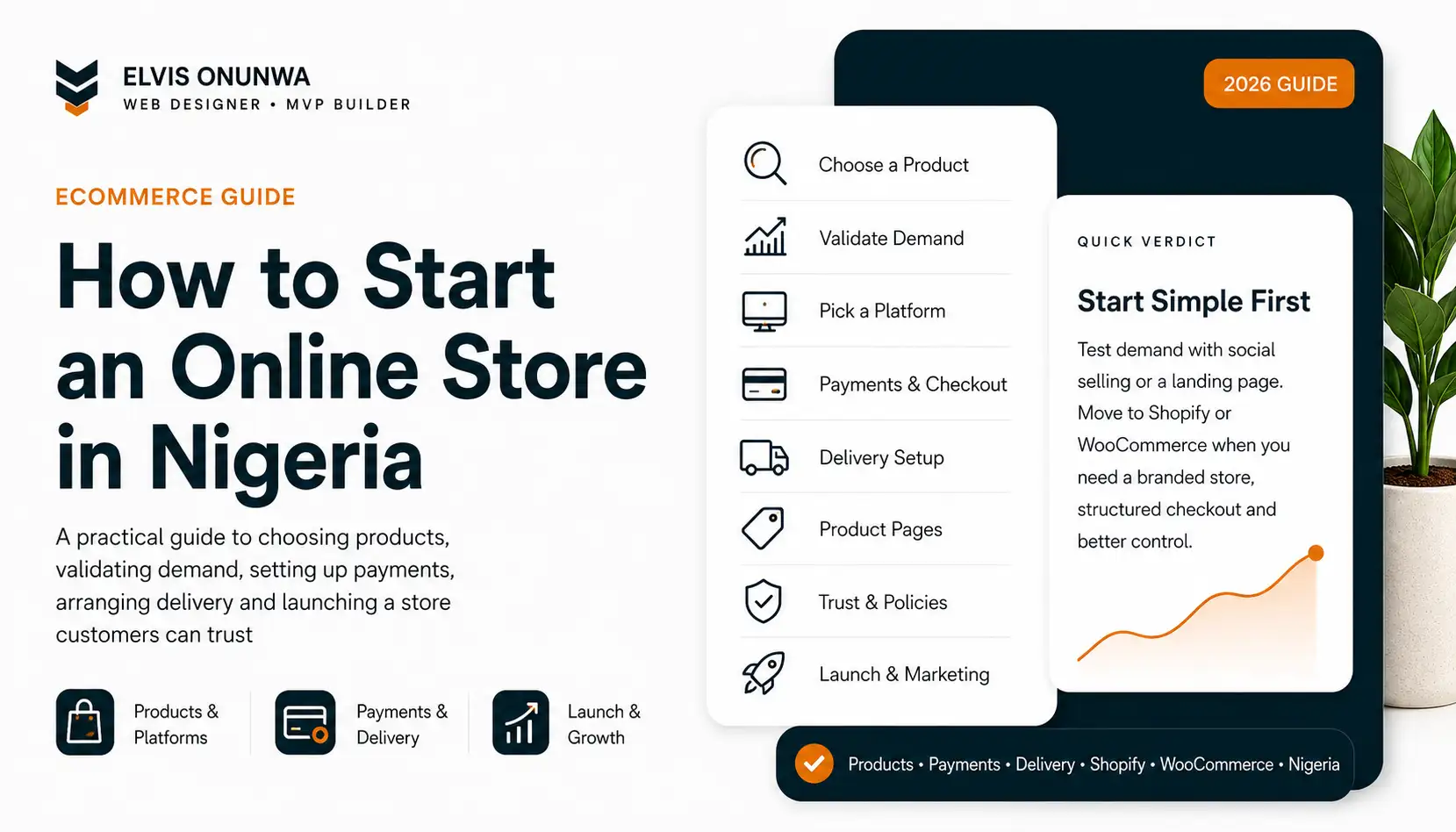
To start an online store in Nigeria, choose a product people are willing to pay for, identify reliable suppliers, calculate your profit after delivery and marketing, select a suitable selling platform, configure local payment methods, arrange fulfilment and test the entire order process before launching.
The website is only one part of the business.
A functional online store also needs:
Products people want
Profitable pricing
Reliable suppliers
Product photographs and descriptions
Payment processing
Inventory records
Delivery arrangements
Customer support
Returns and refund policies
A plan for attracting customers
You do not necessarily need an expensive ecommerce website on your first day. A new seller can validate demand through WhatsApp, Instagram, payment links or a marketplace before investing in a larger platform.
The important thing is to build the business in the correct order: validate the product first, understand the numbers, choose the simplest platform that supports the operation and only add complexity when sales justify it.
What Is an Online Store?
An online store is a business system that allows customers to discover products, place orders, make payments and receive what they purchased without depending entirely on a physical shop.
The visible website or social media page is only the storefront. Behind it, the business must manage pricing, stock, payments, order records, fulfilment, customer communication and returns.
There are four common ways Nigerians describe an online store.
Instagram or WhatsApp business
The seller posts products on Instagram, TikTok or WhatsApp and receives orders through direct messages.
This is often the fastest way to begin because it requires little technical setup. It is useful for validating a product, selling through an existing network or managing a small catalogue.
However, orders are usually processed manually. As sales increase, conversations, payment confirmations, addresses and stock records can become difficult to manage.
Marketplace store
The seller lists products on an established platform such as Jumia or Konga.
The marketplace provides an existing audience and order-management environment, but the merchant pays commissions, competes with many similar listings and has less control over the customer relationship.
Jumia currently states that seller registration is free and that it earns through commissions on successful sales. Konga similarly charges category-based commissions and advertises rates starting from 3%.
Standalone ecommerce website
A standalone ecommerce website gives the business its own domain, product catalogue, checkout, customer records and brand experience.
Platforms such as Shopify and WooCommerce are commonly used for this.
The business controls how products are presented, how customers move through the store and how marketing campaigns are measured. It also becomes responsible for maintaining the catalogue, policies, payment setup and customer experience.
Complete ecommerce operation
A serious ecommerce business includes much more than a website.
It connects:
Product sourcing → Inventory → Storefront → Payment → Order confirmation → Fulfilment → Delivery → Customer service → Returns → Reporting
A beautiful website cannot compensate for weak products, poor delivery, inaccurate inventory or unprofitable customer acquisition.
Decide What You Want to Sell
The first decision is not which website platform to use. It is what you will sell and why customers should buy it from you.
Physical products
Physical products include:
Fashion and footwear
Beauty and skincare products
Electronics and accessories
Home and kitchen products
Books
Food products
Baby products
Automobile accessories
Fitness products
Handmade goods
Physical products require sourcing, storage, packaging and delivery. They may also involve damage, theft, expired stock or unsold inventory.
Digital products
Digital products include:
Ebooks
Templates
Courses
Design assets
Downloads
Paid communities
Software access
Research reports
Digital products do not require physical delivery and can often be sold repeatedly without reproducing the item.
The main challenges are trust, piracy, access control and proving that the information or resource is worth paying for.
Services and bookings
An online store can also sell:
Consultations
Training sessions
Professional services
Event tickets
Appointments
Repairs
Beauty services
Classes
Accommodation bookings
In this case, the store may need a booking calendar, deposits, availability management or recurring payments rather than traditional product inventory.
Questions to answer before choosing a product
Before investing heavily, ask:
Does the product solve a recognisable problem or satisfy an existing desire?
Are people already buying similar products?
Why would they choose mine?
Is the profit margin large enough after payment fees, packaging, delivery and advertising?
Is the product easy to store and transport?
Can the supplier maintain quality?
Can I restock it consistently?
Is repeat purchasing possible?
Can customers confidently buy it without inspecting it physically?
What happens when an order is returned?
A product can sell frequently and still lose money.
For example, if a product costs ₦8,000 to purchase, ₦1,000 to package, ₦3,000 to advertise and ₦2,500 to deliver, selling it for ₦15,000 does not produce a meaningful ₦7,000 profit. Much of that difference has already been consumed by fulfilment and customer acquisition.
Calculate your contribution per order before committing to the product.
Validate Demand Before Building the Store
Product validation means gathering evidence that customers will buy the product at your intended price.
It should happen before you spend heavily on inventory, branding or custom development.
Simple validation methods include:
Interviewing potential customers
Posting product samples on social media
Creating a WhatsApp catalogue
Collecting preorders
Running a small paid advertisement
Selling through an existing marketplace
Creating a one-page landing page
Collecting names, enquiries or deposits
Buying a small test quantity instead of bulk inventory
A preorder is particularly useful when the supplier is reliable and the customer clearly understands the delivery timeline.
However, do not describe an item as immediately available when you have not purchased or confirmed it. Trust is difficult to recover after customers feel misled.
A good validation test answers three questions:
Will people stop and pay attention?
Will they ask serious buying questions?
Will they complete a payment at the intended price?
Likes and compliments are not the same as demand.
Choose Your Ecommerce Business Model
Your business model determines when you buy products, who holds inventory and who fulfils the order.
Model | How it works | Main advantage | Main risk |
|---|---|---|---|
Own inventory | You purchase and store products before customers order | Better control over quality, speed and margins | Unsold or damaged stock |
Preorder | Customers order before you purchase or manufacture the product | Lower inventory risk | Longer fulfilment time |
Dropshipping | A supplier stores and ships the product | Low starting inventory | Weak quality and delivery control |
Made to order | Production starts after an order is confirmed | Less waste and personalisation | Slower delivery |
Digital products | Customers receive online access or downloads | No physical fulfilment | Piracy and trust |
Marketplace selling | Products are sold through an established marketplace | Existing traffic and infrastructure | Commissions and limited customer ownership |
Practical Nigerian verdict
Own inventory works best when customers expect fast delivery and you have already validated demand. Start with a controlled quantity rather than filling a warehouse.
Preorders are suitable for imported products, fashion drops, books and specialised items, provided delivery dates are communicated honestly.
Dropshipping can reduce initial capital requirements, but the seller remains responsible to the customer. A supplier’s mistake becomes your customer-service problem.
Made-to-order selling is useful for furniture, cakes, clothing, gifts and personalised products. Your production timeline should be displayed before payment.
Digital products offer strong margins but require credibility, clear previews and dependable access after payment.
Marketplace selling can help a new merchant reach buyers, but it should not be the only long-term channel. Build an owned audience through email, WhatsApp, social media or your own website.
Write a Simple Online Store Business Plan
You do not need a fifty-page business plan before selling your first product.
A one-page plan is enough to expose weak assumptions.
Include:
Product
Target customer
Problem or desire
Supplier
Purchase cost
Packaging cost
Selling price
Payment charge
Expected delivery cost
Expected profit per order
Primary sales channel
Payment method
Delivery partner
Monthly marketing budget
Three-month sales target
Calculate at least three scenarios:
What happens if sales are lower than expected?
What happens if advertising becomes more expensive?
What happens if the supplier increases the price?
Do not build a business that survives only when every assumption works perfectly.
Calculate the Real Cost of Starting
The cost of starting an online store in Nigeria depends on the product, inventory model, platform and level of professional help required.
Separate your budget into four groups.
Business setup
This may include:
Business registration
Brand name
Logo and visual identity
Business bank account
Professional advice
Record-keeping setup
Products and operations
This may include:
Initial inventory
Product samples
Packaging
Product photography
Storage
Labels
Delivery materials
Damaged or returned stock
Technology
This may include:
Domain registration
Ecommerce platform
Website design and development
Hosting
Theme
Apps or plugins
Business email
Payment integration
Maintenance
Sales and marketing
This may include:
Social media content
Product videos
Influencer promotion
Paid advertising
Discounts
Referral incentives
Email or SMS marketing
Store type | Typical setup | Relative investment |
Social-first starter | Instagram, WhatsApp, payment links and manual order records | Lowest |
Standard ecommerce store | Shopify or WooCommerce, local payments and structured catalogue | Moderate |
Custom ecommerce platform | Custom catalogue, inventory, order workflows and integrations | Highest |
Do not use these categories as fixed prices. A store with five carefully prepared products may cost less to launch than one with 500 products, even when both use the same platform.
For detailed Nigerian pricing, see the complete breakdown of ecommerce website costs in Nigeria.
Register the Business and Set Up Its Finances
Choose a business name that is easy to remember and broad enough to accommodate future products.
Depending on the structure and stage of the business, you may need to register a business name or company with the Corporate Affairs Commission. CAC currently provides online name checks and end-to-end registration through its Company Registration Portal.
Registration can become important when:
Opening certain business bank accounts
Applying to payment providers
Joining marketplaces
Working with corporate clients
Protecting the business identity
Separating the business from personal activity
For example, Jumia’s published seller verification requirements for registered businesses include CAC documentation, a tax identification number and a bank account in the establishment’s name. Requirements can vary by seller type and platform.
Also:
Keep business and personal money separate
Record every sale and expense
Keep supplier invoices
Issue receipts
Reconcile payment settlements
Record customer balances and refunds
Obtain tax advice for your exact structure
The Joint Revenue Board provides individual and corporate Tax ID services, while FIRS operates systems for federal tax registration and administration. Tax obligations depend on the business type, turnover and activities, so seek professional advice rather than relying on a general ecommerce article.
A tool such as Berlvis Books can help a small business record sales, payments, customer balances and everyday business activity without mixing everything inside personal chats or notebooks.
Choose Where You Will Sell
The best platform is the one that supports your current operation without creating unnecessary cost or complexity.
Instagram and WhatsApp
Social selling is best for:
Validating a product
Starting with a small catalogue
Selling through personal relationships
Answering customer questions directly
Running a preorder
Its limitations include:
Manual order tracking
Poor catalogue discovery
Difficult inventory management
Repeated customer questions
Limited Google visibility
Lower trust among unfamiliar customers
Use social media as a customer-acquisition channel, not necessarily as your entire operating system.
Online marketplaces
Marketplaces provide access to customers who already visit the platform intending to buy.
Before joining, compare:
Commission rates
Product restrictions
Seller verification requirements
Fulfilment deadlines
Return responsibilities
Payment schedules
Competition
Packaging requirements
Customer-service rules
Marketplace traffic is valuable, but you do not fully own the platform or customer relationship. Rules, visibility and commissions can change.
Shopify
Shopify is a hosted ecommerce platform. Hosting, SSL and the main store-management infrastructure are included in the subscription.
It is a good fit for merchants who want:
A simpler technical setup
Managed hosting
A structured product dashboard
Themes and apps
Built-in checkout
Less server maintenance
Shopify’s Nigerian pricing page currently lists Basic at US$27 when paid monthly or a US$19 monthly equivalent when billed annually. It also lists a 2% third-party payment-provider fee on Basic. Prices and promotions can change, so check the live pricing page before committing.
Shopify Payments is not currently listed as available to businesses located in Nigeria. Nigerian merchants therefore generally use a third-party gateway such as Paystack or Flutterwave, which can mean paying both the gateway’s processing charge and Shopify’s applicable third-party transaction fee.
See the full Shopify development cost in Nigeria breakdown before selecting a plan.
WooCommerce
WooCommerce is an ecommerce plugin for WordPress.
The core software is open source, but the store still needs hosting, a domain, configuration, security, backups and maintenance. WooCommerce’s own documentation describes web hosting as the place where the store lives and recommends confirming that the server meets its performance and security requirements.
WooCommerce is suitable when the business wants:
More control over the website
Strong blogging or content features
Flexible product structures
Custom checkout behaviour
Direct control over hosting and data
Access to a large plugin ecosystem
The trade-off is greater technical responsibility. Themes, plugins, WordPress and server software must be maintained carefully.
Read the WordPress website cost in Nigeria guide before treating WooCommerce as automatically free.
Custom ecommerce development
Custom development becomes reasonable when a standard platform cannot support the operation efficiently.
Examples include:
Wholesale and retail pricing
Multiple vendors
Customer wallets
Complex inventory
Subscription workflows
Bespoke delivery calculations
Product configuration tools
Internal operational dashboards
Unusual approval or checkout processes
Do not build custom technology merely to appear sophisticated. Standard ecommerce features such as carts, checkout, order emails and product variants have already been solved well by existing platforms.
Factor | Social selling | Marketplace | Shopify | WooCommerce | Custom |
Starting cost | Low | Low to moderate | Moderate | Moderate | High |
Technical difficulty | Low | Low | Low to moderate | Moderate to high | High |
Control | Low | Low | High | High | Highest |
Maintenance | Manual operations | Platform-managed | Mostly platform-managed | Owner-managed | Custom responsibility |
Scalability | Limited | Moderate | High | High with good hosting | Depends on architecture |
Best for | Validation | Accessing marketplace demand | Simpler branded retail | Flexible, content-led stores | Complex operations |
For a detailed platform decision, read Shopify vs WooCommerce in Nigeria.
Choose and Register Your Domain Name
A good domain should be:
Short
Easy to pronounce
Easy to spell
Related to the brand
Free from unnecessary numbers or symbols
Suitable if the business expands beyond one product
A .com domain works well for a business with international ambitions. A .com.ng or .ng domain can communicate a clear Nigerian connection.
Check the renewal price, not only the first-year promotional price.
The business owner should control the registrar account, recovery email and payment method. A developer can help configure the domain, but should not permanently register it under a private account the business cannot access.
Also confirm that similar usernames are available on the social platforms you plan to use.
Plan the Essential Store Pages
Every serious ecommerce website needs more than a homepage and product grid.
Homepage
The homepage should quickly communicate:
What the store sells
Who the products are for
The main customer benefit
Important categories
Best-selling products
Delivery coverage
Trust indicators
A clear next action
Shop and category pages
Use clear categories rather than forcing customers to scroll through an unorganised catalogue.
Depending on the product range, include:
Search
Filters
Price ranges
Sizes
Colours
Brands
Availability
Sorting
Product pages
Each product page should contain:
Product name
Clear photographs
Price
Available variants
Size or technical specifications
Benefits
Stock status
Delivery estimate
Return information
Add-to-cart button
Do not make customers contact WhatsApp to discover every price. Conversations should help close a sale, not compensate for incomplete product information.
About page
Explain:
Why the business exists
Who runs it
What makes the products different
How quality is controlled
Why a new customer should trust the store
Contact page
Include:
WhatsApp
Email
Phone number
Support hours
Expected response time
Policy pages
At minimum, publish:
Delivery policy
Return and refund policy
Privacy policy
Terms and conditions
Policies should match how the business actually operates. The FCCPC has emphasised timely delivery, fair return windows, prompt refunds and respect for cancellations as important online-market obligations.
An online store also collects personal information such as names, phone numbers, addresses and payment-related records. The Nigeria Data Protection Commission regulates personal-data protection under the Nigeria Data Protection Act 2023, so collect only necessary information and explain how it is used and protected.
Prepare Product Images and Descriptions
Customers cannot physically inspect your products before ordering.
Your images and descriptions must reduce that uncertainty.
Use:
Multiple product angles
Consistent backgrounds
Accurate colours
Close-up details
Dimensions or scale references
Product videos where useful
Separate photographs for major variants
Mobile-friendly image sizes
Avoid editing images so heavily that the delivered product looks different.
A useful description structure is:
What the product is
Who it is for
What problem it solves
Main benefits
Features and specifications
Size, material or ingredients
Care instructions
Delivery and return information
Do not copy a generic supplier description without checking it. Supplier copy may be inaccurate, duplicated across many websites or written for a different customer.
Set Up Online Payments
Nigerian customers may expect to pay through:
Debit or credit card
Bank transfer
USSD
Direct bank payment
Payment link
Mobile money where supported
Payment on delivery in selected cases
Paystack
Paystack supports channels including cards, bank accounts, bank transfers, USSD and QR-based methods, depending on the merchant’s configuration and customer location.
Its current standard Nigerian pricing is:
Local transactions: 1.5% plus ₦100
The ₦100 fee is waived below ₦2,500
Local fees are capped at ₦2,000
International transactions: 3.9% plus ₦100
Paystack states that standard integration and maintenance are free.
Flutterwave
Flutterwave is another major option for Nigerian merchants. Its supported Nigerian methods include cards, USSD, bank transfers, account payments and other channels shown in the merchant’s configuration.
Flutterwave’s published Nigerian pricing currently shows a total 2% charge for domestic payment collection, although payment method, business agreement and future changes may affect the final fee. Check the live pricing page when making a decision.
Neither gateway is universally better for every business. Compare:
Supported payment methods
Settlement timeline
International payment requirements
Platform integration
Refund tools
Reconciliation
Support
Total transaction cost
See the planned Paystack vs Flutterwave comparison for a deeper decision guide.
Direct bank transfers
Manual transfer appears simple but creates operational problems:
Fake transfer alerts
Manual confirmation
Incorrect payment references
Delayed order processing
Difficult reconciliation
Multiple customers paying similar amounts
Do not mark an order as paid based only on a screenshot or SMS alert. Verify the transaction in the bank account or payment system.
Payment on delivery
Payment on delivery can reduce buyer hesitation, but it introduces:
Fake orders
Failed delivery attempts
Logistics losses
Cash handling
Delayed settlement
Low customer commitment
Consider limiting payment on delivery by location, order value or customer history. Confirmation calls or small deposits can reduce failed deliveries.
Arrange Delivery and Fulfilment
Delivery is part of the product experience.
A customer does not separate the courier from the store when an order arrives late or damaged.
Local delivery
For same-city orders, use reliable dispatch riders or scheduled delivery services.
Define:
Pickup times
Same-day cut-off
Delivery zones
Failed-delivery charges
Proof of delivery
Handling requirements
Nationwide delivery
For interstate orders, compare courier coverage, tracking, pickup centres, insurance, return handling and delivery speed.
GIG Logistics advertises ecommerce delivery across all 36 states, along with Shopify and WordPress plugins and API integration. NIPOST also provides nationwide merchandise-delivery services through products such as Speedpost. These are examples rather than universal recommendations; compare performance for your routes and product type.
International delivery
International selling introduces:
Customs documentation
Import restrictions
Shipping fees
Insurance
Currency conversion
Duties
Longer timelines
Product-specific restrictions
Do not promise international delivery before confirming that the product can legally and economically be shipped to the destination.
For every delivery level, decide:
Who pays the delivery fee?
Is the fee fixed or calculated?
Which locations are covered?
When does fulfilment begin?
How are fragile products handled?
What happens after a failed attempt?
How can the customer track the order?
Who manages returns?
Set Up Inventory and Order Management
WhatsApp and spreadsheets may be sufficient for the first few orders, but they become risky when volume grows.
Your system should track:
Product
Variant
SKU
Stock quantity
Cost price
Selling price
Customer
Payment status
Fulfilment status
Delivery details
Refunds
Returns
Damaged stock
Decide exactly when inventory reduces.
Possible events include:
When an order is placed
When payment is confirmed
When the seller accepts the order
When the product is dispatched
The correct event depends on the business, but it must be consistent. Otherwise two customers may purchase the same final item.
Build Trust Before Asking Customers to Pay
An unfamiliar customer may check your website, Instagram page, Google results and WhatsApp profile before completing a payment.
Useful trust signals include:
Clear business identity
Real contact details
Domain-based email
Secure checkout
Transparent pricing
Real product photographs
Customer reviews
Delivery information
Return policy
Consistent branding
Responsive support
Trust is not created by displaying random security icons or unverified testimonials.
It is created when the business behaves consistently across every customer touchpoint.
Test the Store Before Launching
Before advertising, complete the entire journey as though you were a customer.
Test on Android and iPhone
Place a real order
Test a successful payment
Test a failed payment
Confirm order notifications
Test discount codes
Test out-of-stock products
Test product variants
Verify delivery charges
Check order records
Test the refund process
Review spelling and prices
Confirm policies are visible
Test WhatsApp and email links
Check website speed
Testing only the homepage is not enough. The most expensive problems usually occur around checkout, payment confirmation, inventory and delivery.
Launch the Online Store
A controlled launch is safer than immediately spending heavily on advertising.
Soft launch
Begin with:
Existing customers
Friends and trusted contacts
A small WhatsApp or email list
A limited product range
A small advertising budget
Ask early customers about:
Product clarity
Payment experience
Delivery communication
Packaging
Website usability
Missing information
Fix repeated problems before expanding.
Full launch
After the workflow is stable, grow through:
Social media
WhatsApp broadcasts
Email marketing
Search engine optimisation
Influencers
Referral programmes
Paid advertising
Partnerships
Marketplaces
How to Get Your First Customers
Building a store does not automatically create demand.
Personal network
Your network can provide the first customers, testimonials and referrals.
However, friends and family are not a permanent acquisition strategy. The business must eventually reach people who do not already know the founder.
Instagram and TikTok content
Useful ecommerce content includes:
Product demonstrations
Before-and-after results
Customer use cases
Product education
Comparisons
Frequently asked questions
Behind-the-scenes production
Packaging and delivery videos
Do not post only static product photographs with “available” as the caption. Show the product in use.
WhatsApp marketing
Use:
Status updates
Catalogues
Broadcast lists
Customer follow-ups
Restock announcements
Abandoned-order recovery
Post-purchase support
Do not add customers to groups or overwhelm them with messages without consent.
Google Search
Search visibility can bring customers who are actively looking for a product.
Optimise:
Product titles
Category names
Product descriptions
Image alternative text
Page titles
Meta descriptions
Local business information
Search optimisation takes time, but it reduces complete dependence on paid social media.
Paid advertising
Before increasing advertising spend, understand:
Customer acquisition cost
Conversion rate
Average order value
Gross margin
Repeat purchase rate
A store is not sustainable when acquiring one customer costs more than the profit earned from that customer.
For example, if the average gross profit per first order is ₦5,000 and acquiring the customer costs ₦7,000, the store loses money unless repeat purchases reliably recover the difference.
Track the Numbers That Matter
Track:
Website visitors
Product-page views
Add-to-cart rate
Checkout completion rate
Conversion rate
Average order value
Gross profit per order
Customer acquisition cost
Delivery failure rate
Return rate
Repeat purchase rate
Revenue alone does not show whether the business is healthy.
A store can generate ₦5 million in sales and still lose money after product costs, advertising, transaction fees, failed delivery attempts and returns.
Common Mistakes to Avoid
Avoid:
Buying too much inventory before validation
Choosing a platform only because it is popular
Using poor product images
Hiding delivery costs until checkout
Depending entirely on Instagram
Mixing personal and business finances
Offering payment on delivery everywhere
Ignoring mobile users
Installing unnecessary apps or plugins
Launching without testing payments
Spending on advertising before fixing the offer
Building features the business does not need
Allowing a developer to control the domain permanently
Treating revenue as profit
How Much Does It Cost to Start an Online Store in Nigeria?
There is no honest universal minimum.
The final amount depends on:
Product and inventory
Website setup
Domain and hosting
Payment fees
Packaging
Logistics
Product content
Marketing
Maintenance
A preorder or social-first business can begin with a small test budget because it avoids large inventory and complex technology.
A professionally developed ecommerce store usually requires a larger investment. For example, a lean first-year Shopify setup can run into several hundred thousand naira before inventory, delivery and advertising are added.
For detailed estimates, read:
Which Online Store Setup Is Right for You?
Situation | Recommended starting point |
Testing one product | Landing page, WhatsApp and payment link |
Small catalogue and limited budget | Social selling plus simple storefront |
Growing retail brand | Shopify or WooCommerce |
Content-heavy business | WooCommerce |
Merchant wanting simpler maintenance | Shopify |
Complex operations | Custom ecommerce platform |
Marketplace-dependent seller | Marketplace plus an owned customer channel |
Start with the simplest system that can reliably handle the next stage of the business.
When Should You Hire an Ecommerce Developer?
Professional help becomes useful when the store needs:
Payment integration
Product variants
Inventory management
Delivery automation
Customer accounts
Order dashboards
Search optimisation
Custom checkout
Marketplace functionality
Data migration
Reliable maintenance
A developer should not merely install a theme. They should help ensure that products, payment, inventory, delivery and order records work together.
When you are ready to move from manual selling to a structured store, you can build your online store with Elvis Onunwa or review the wider web design services available in Nigeria.
Online Store Launch Checklist
Business
Product validated
Supplier confirmed
Purchase and selling prices calculated
Payment and delivery costs included
Policies written
Business finances separated
Sales and expense records prepared
Store
Domain registered under business control
Platform selected
Products uploaded
Images and descriptions complete
Mobile design tested
Payments working
Delivery configured
Order notifications working
Inventory behaviour tested
Policies visible
Marketing
Launch content prepared
Social accounts active
WhatsApp catalogue ready
Analytics installed
First campaign planned
Customer follow-up process ready
Frequently Asked Questions
How much do I need to start an online store in Nigeria?
The amount depends on the product and business model. A preorder or social-first store can start with a controlled test budget, while a professionally developed store with inventory, photography, packaging and advertising may require several hundred thousand naira or more.
Can I start an online store without a website?
Yes. You can begin with WhatsApp, Instagram, payment links or marketplaces. A standalone website becomes more useful when you need greater trust, automated checkout, search visibility, customer records and structured inventory.
Is Shopify available in Nigeria?
Yes. Nigerian merchants can create and run Shopify stores. However, Shopify Payments is not currently listed as available in Nigeria, so merchants generally use third-party payment providers such as Paystack or Flutterwave.
Can I use Paystack on my online store?
Yes. Paystack can be integrated with ecommerce websites and supports Nigerian payment channels such as cards, bank transfers and USSD, depending on the integration and account configuration.
Which is better for Nigeria, Shopify or WooCommerce?
Shopify is often better for merchants who want simpler maintenance and managed hosting. WooCommerce is often better for businesses that want greater control, strong content features and flexible customisation. The correct choice depends on your budget, technical capacity and required workflows.
Do I need to register my online business with CAC?
Not every small product test begins with a registered company, but registration becomes increasingly important when opening business accounts, joining some marketplaces, applying to payment providers, working with corporate customers or formalising the business. Obtain professional advice for your exact situation.
How do I deliver products to customers across Nigeria?
You can use local dispatch riders for same-city orders and nationwide courier companies or pickup networks for interstate orders. Compare coverage, price, tracking, failed-delivery policies, insurance and return handling before choosing a provider.
Can I start an online store without holding inventory?
Yes. Preorders, dropshipping, made-to-order products, digital products and marketplace fulfilment can reduce the need to hold stock. Each model creates different risks around quality, delivery time and customer trust.
What products sell well online in Nigeria?
Products with recognisable demand, clear value, acceptable delivery costs and enough profit margin have the strongest potential. Fashion, beauty, accessories, home products, electronics, food, books and digital products can all sell, but the specific offer must still be validated.
How long does it take to build an ecommerce website?
A simple theme-based store can take a few weeks when products, photographs and copy are ready. A larger catalogue, custom design, migration or complex integrations can take significantly longer.
Conclusion
Starting an online store in Nigeria is not primarily a website-design exercise.
Begin with a validated product. Understand the purchase cost, delivery cost, payment charges, marketing cost and expected profit. Choose the simplest platform that supports the current business. Configure reliable payments and delivery. Test every important workflow and launch to a controlled audience before spending heavily on advertising.
The right store is not the one with the most features. It is the one that helps customers understand the product, trust the business, pay successfully and receive what they ordered.
Ready to launch? Build your online store.
Still planning your budget? See ecommerce website costs in Nigeria.