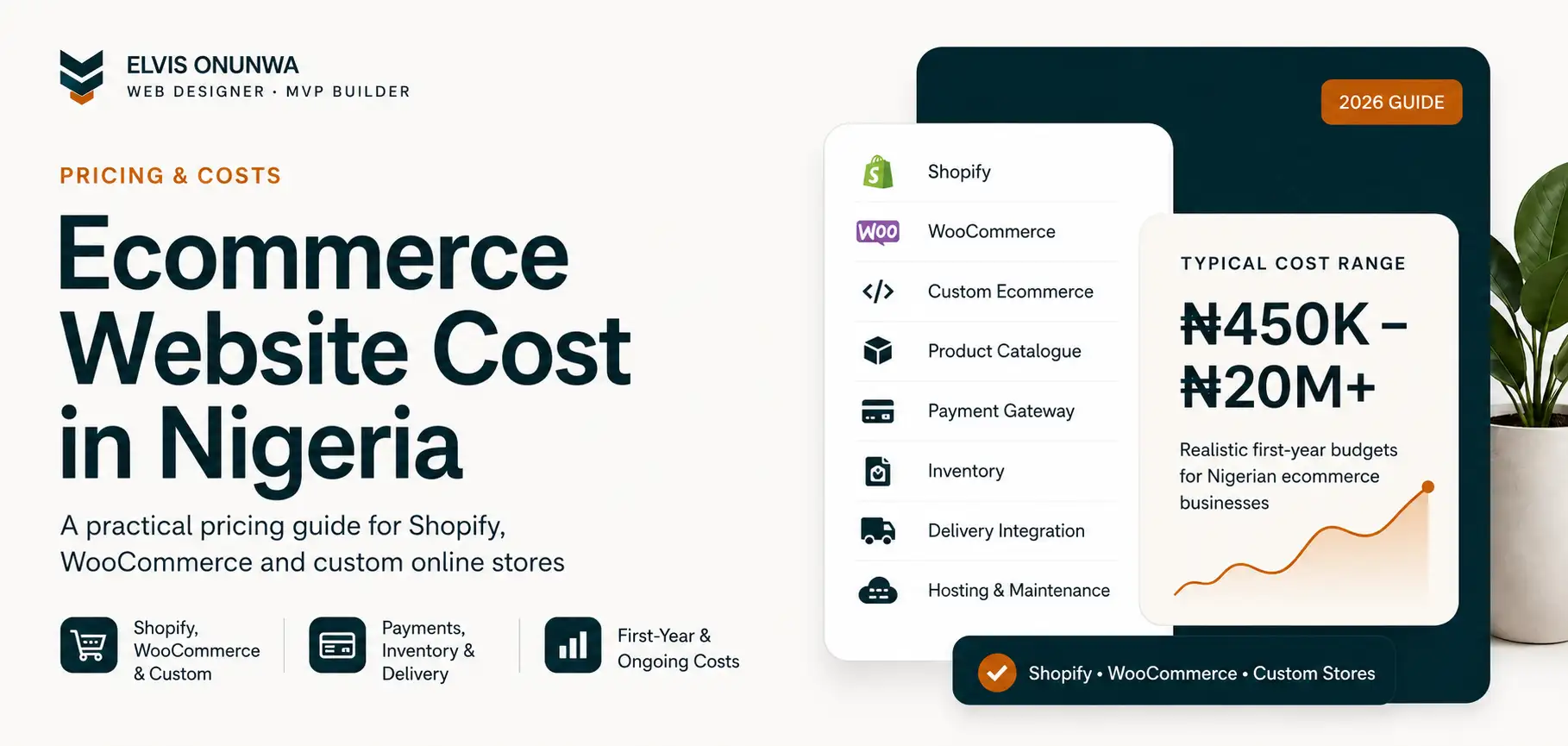
A professional ecommerce website in Nigeria can cost about ₦450,000 for a focused small store or several million naira for a more complex commerce system.
The number becomes easier to understand when you stop treating “an ecommerce website” as one product.
A store with 25 clean products, one payment gateway and simple delivery zones is a different job from a store with 1,500 SKUs, multiple warehouses, wholesale pricing, custom inventory logic and ERP integration.
So the useful question is not only:
How much does an ecommerce website cost in Nigeria?
It is:
What kind of selling system are you actually asking someone to build and operate?
This guide separates the build cost from the recurring costs that usually get hidden inside vague ecommerce quotes.
Pricing checked on September 5, 2026. Platform and payment-provider prices can change. Use the official links in this guide to verify current figures before making a long-term decision.
Ecommerce website cost in Nigeria at a glance
These are practical planning bands, not regulated industry tariffs.
| Type of ecommerce project | Practical build budget | What it usually means |
|---|---|---|
| Very small template/storefront setup | ₦200,000–₦450,000 | Small catalogue, simple theme, basic payment and delivery setup |
| Professional small-business store | ₦450,000–₦1.2 million | Better UX, product setup, Paystack, delivery rules, analytics and launch testing |
| Growth-focused Shopify or WooCommerce store | ₦1 million–₦2.5 million | Larger catalogue, stronger design, migration, apps/plugins, automation and deeper testing |
| Highly customised ecommerce build | ₦2 million–₦4 million+ | Custom sections, complex integrations, product workflows, advanced analytics or operations |
| Custom marketplace / commerce platform | ₦4 million+ | Bespoke software, vendors, wallets, custom permissions, settlement, inventory or business logic |
The build price is only one layer. Your first-year total can also include:
- platform subscription or hosting;
- domain renewal;
- payment-processing fees;
- premium apps or plugins;
- product photography and catalogue preparation;
- logistics tools;
- email/SMS services;
- maintenance and technical support;
- SEO, ads and conversion work.
This is why a ₦350,000 quote and a ₦1.5 million quote can both be reasonable—or both be poor value—depending on what is actually included.
What current Nigerian market pages are quoting
Current Nigerian pricing pages show a wide spread rather than one reliable “average.” Public 2026 examples place ecommerce work from roughly ₦500,000–₦700,000 at the lower end to ₦2 million–₦3.5 million+ for more involved projects.
That range is consistent with the reality that some providers are quoting a theme-led store setup while others include product preparation, payments, delivery, analytics, SEO, custom design and post-launch support.
So I would not choose a provider because their number is closest to a supposed market average. Compare the scope behind the number.
The seven things that usually determine the real cost
1. Product catalogue quality
A store with 50 products can be more expensive than one with 500 if the product information is disorganised.
The cheapest project starts with a clean spreadsheet containing:
- product name;
- category;
- price;
- SKU;
- stock quantity;
- variants such as size or colour;
- weight or delivery class;
- description;
- image filenames.
If a developer has to pull prices from WhatsApp, rename every image, invent SKUs and work out which photo belongs to which variant, catalogue preparation becomes a significant part of the project.
2. Platform choice
The three common routes are Shopify, WooCommerce and a custom build.
A fourth route matters for very early validation: do not build a full ecommerce system yet.
If you only need to test whether people will buy a small catalogue, Paystack Storefront is available to Nigerian Paystack merchants and Paystack says there is no separate storefront subscription; you pay transaction fees on successful sales. That can be a smarter first step than spending seven figures before demand is proven. Paystack Storefront
3. Payment economics
Payment integration is not just adding a button.
You need to understand:
- gateway fees;
- Shopify third-party fees where applicable;
- local vs international cards;
- failed and abandoned payments;
- refunds;
- settlement currency;
- how the store verifies that an order is actually paid.
4. Delivery and fulfilment
A store that charges one flat delivery fee is cheaper to configure than one with multiple delivery partners, weight bands, same-day zones, pickup points and live-rate integrations.
The website should reflect a delivery process your team can actually execute.
5. Design and conversion work
Installing a theme is not the same thing as designing a buying experience.
More work is required when the project includes custom product pages, filters, trust content, bundles, upsells, landing pages, mobile optimisation, abandoned-cart flows and conversion testing.
6. Integrations
Costs rise when the store needs to connect to:
- accounting software;
- POS systems;
- inventory tools;
- warehouse software;
- CRM;
- ERP;
- email/SMS tools;
- courier APIs;
- loyalty systems;
- marketplaces.
7. Maintenance responsibility
Someone still has to own the store after launch.
That includes app/plugin updates, backups, checkout testing, product changes, broken integrations, analytics, payment problems and performance.
For a separate breakdown, see my website maintenance packages guide.
Shopify ecommerce cost in Nigeria
Shopify is attractive because hosting, the commerce engine, SSL and platform maintenance are bundled into the subscription.
As of September 5, 2026, Shopify’s Nigeria pricing page lists these yearly-billing rates:
| Shopify plan | Current yearly-billing price | Third-party payment-provider fee |
|---|---|---|
| Basic | US$19/month | 2% |
| Grow | US$54/month | 1% |
| Advanced | US$299/month | 0.6% |
| Plus | From US$2,300/month | Plan-specific |
Source: Shopify Nigeria pricing
Those fees matter in Nigeria because merchants often need a third-party payment provider rather than Shopify Payments.
Shopify’s subscription is therefore not the total cost of running the store. You may also pay for apps, a theme, development, payment processing, product work, logistics and ongoing support.
For the platform-specific decision, read Shopify in Nigeria: payments, plans and store setup. For project pricing, use the separate Shopify development cost guide.
WooCommerce ecommerce cost in Nigeria
WooCommerce takes a different approach.
WooCommerce says its core platform is free and open source, with no platform revenue share. You choose the hosting and pay only for the extensions and services your store needs. Its current global pricing guide estimates hosting for many stores at roughly US$25–US$350/month and paid extensions commonly around US$29–US$299/year each. WooCommerce pricing
That does not mean WooCommerce is automatically cheaper.
You still need to budget for:
- WordPress hosting;
- backups and security;
- theme/custom design;
- payment setup;
- premium plugins where needed;
- updates and compatibility testing;
- developer support.
WooCommerce is often a strong fit when you value WordPress ownership and flexibility and have someone responsible for maintenance.
For the practical local setup, see WooCommerce in Nigeria: Paystack, costs and store setup.
Paystack fees belong in your ecommerce budget
Paystack currently lists Nigerian local transactions at 1.5% + ₦100. The ₦100 portion is waived for transactions below ₦2,500, and local transaction fees are capped at ₦2,000. Its standard international-card rate is 3.9% + ₦100 for Mastercard, Visa and Verve transactions. Paystack pricing
That fee is separate from your website-development cost.
On Shopify, it can also sit alongside Shopify’s third-party payment-provider fee.
For example, if a Nigerian Shopify Basic store processes a ₦100,000 local card order through Paystack, the merchant needs to account for:
- Paystack’s processing fee under the current pricing rules; and
- Shopify’s 2% third-party payment-provider fee on Basic.
The exact deduction can depend on the payment type and current terms, so build your margin model from the providers’ current documentation rather than a screenshot from an old tutorial.
What does AI-assisted ecommerce development change?
AI-assisted tools can reduce some development time.
I use AI-assisted development in real product work to accelerate things such as:
- component scaffolding;
- UI iteration;
- repetitive code changes;
- test generation;
- documentation;
- data-cleanup scripts;
- debugging and refactoring.
That can make some implementation work faster.
But AI does not remove the expensive decisions in ecommerce.
Someone still has to define and verify:
- when an order becomes paid;
- what happens after a failed payment;
- how stock changes after checkout;
- how refunds affect inventory;
- who can change prices;
- what happens when two systems disagree;
- how delivery fees are calculated;
- how customer data is protected;
- what gets tested before release.
A cheap AI-generated storefront can look complete while still having weak payment, inventory or operational logic.
So when comparing an AI-assisted developer with a traditional agency, do not ask only how quickly the pages can be produced. Ask who is responsible for architecture, testing, security, data integrity and release acceptance.
When a ₦200,000 ecommerce budget can make sense
₦200,000 is not automatically impossible. It simply changes the scope.
It can make sense when:
- the catalogue is very small;
- product information is already prepared;
- a template is acceptable;
- delivery rules are simple;
- there are no custom integrations;
- the business accepts a lean first version;
- support after launch is limited.
It is less realistic when the expectation includes custom design, hundreds of products, automation, advanced inventory, custom logistics, SEO migration, email flows and long-term support.
For an even earlier-stage business, a Paystack Storefront or another lightweight commerce option may be a better use of money while you validate demand.
What a professional ecommerce quote should include
Before choosing a provider, ask for a scope that separates:
| Cost area | What should be explicit |
|---|---|
| Strategy | Store goals, customer journey, catalogue structure |
| Design | Theme setup vs custom design, mobile states, product/collection pages |
| Products | Number of products/variants and who prepares the data |
| Payments | Gateway setup, testing, failed-payment handling, refunds |
| Delivery | Zones, rates, pickup, courier integrations |
| Tracking | Analytics, ad pixels, conversion events |
| SEO | Titles, redirects, indexation, product/collection structure |
| Training | Who is trained to run the store after handover |
| Maintenance | Included period, response time, extra-work rate |
| Ownership | Domain, hosting/platform account, code, data and app subscriptions |
A quote that does not tell you what happens after payment succeeds or fails is not detailed enough for an ecommerce project.
Shopify vs WooCommerce vs custom: which budget is sensible?
| Situation | Usually evaluate first |
|---|---|
| Small brand moving from Instagram/WhatsApp | Paystack Storefront, Shopify Basic or lean WooCommerce |
| Brand that wants low infrastructure responsibility | Shopify |
| Business already strong on WordPress and needs flexibility | WooCommerce |
| Store with unusual workflows but still conventional commerce | Shopify/WooCommerce plus targeted customisation |
| Marketplace, wallet, vendor settlement or complex operational logic | Custom application architecture |
Do not pay for custom software merely because it sounds more sophisticated.
Likewise, do not force a complex business into a collection of plugins simply because WooCommerce is free.
The right architecture is the cheapest one that can safely support the real operation.
First-year ecommerce budget checklist
Before approving a project, calculate all of these separately:
- Design and development
- Platform subscription or hosting
- Domain renewal
- Payment-processing fees
- Shopify third-party fees where relevant
- Theme and apps/plugins
- Product photography and catalogue preparation
- Delivery/logistics integration
- Email/SMS/marketing tools
- Maintenance and developer support
- Analytics/SEO setup
- Contingency for integrations and scope changes
That produces a far more useful number than asking for “the price of an ecommerce website.”
Final answer
For a Nigerian small business, ₦450,000–₦1.2 million is a practical starting planning range for a professional focused ecommerce store. More customised Shopify or WooCommerce work can move into the ₦1 million–₦4 million range, while a custom marketplace or commerce platform can cost several million naira more.
The more important lesson is that build price is only the first number.
Your real ecommerce cost is:
build + platform/hosting + payments + product data + delivery + maintenance + growth.
If you already know your product count, payment method, delivery model and platform preference, I can help turn those requirements into a clearer scope through my web design service or you can send the project details.