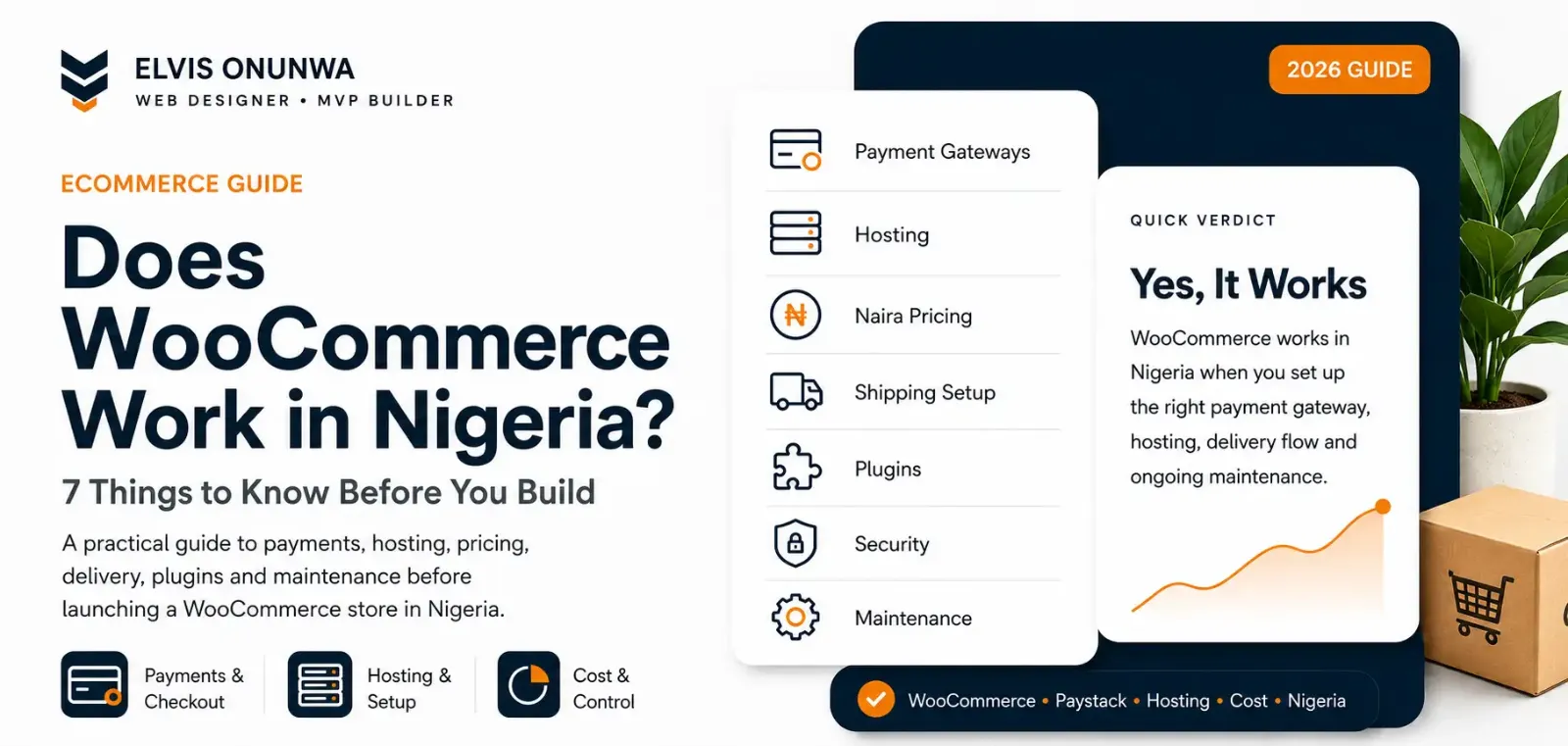
Yes, WooCommerce works in Nigeria. A Nigerian business can run an online store on WordPress, price products in naira, connect Paystack, configure delivery zones and keep far more control over hosting and site behaviour than it would have on a fully hosted ecommerce platform.
But “WooCommerce is free” is only partly true.
The core plugin is free. A dependable store still needs hosting, a domain, payment processing, shipping rules, security, backups, maintenance and a clear fulfilment process after the customer clicks Place order.
This guide focuses on the part Nigerian merchants actually need to get right: how WooCommerce, Paystack, hosting, delivery and ongoing ownership fit together in 2026.
Platform and payment details checked September 8, 2026. WooCommerce, WordPress and Paystack change over time, so verify live provider documentation before launch.
WooCommerce in Nigeria at a glance
| Question | Practical answer |
|---|---|
| Does WooCommerce work in Nigeria? | Yes. It runs on self-hosted WordPress and can be configured for Nigerian stores. |
| Can I accept Nigerian online payments? | Yes. Paystack provides an official WooCommerce extension. |
| Can I price products in naira? | Yes. NGN can be your store currency. |
| Is WooCommerce free? | The core plugin is free; the complete store still has infrastructure, payment and maintenance costs. |
| Does it handle delivery? | WooCommerce provides shipping zones and core methods; courier automation may require an extension or custom integration. |
| Who is it best for? | Businesses that value WordPress ownership and flexibility and can take responsibility for maintenance. |
If you only need the decision: choose WooCommerce when control matters and somebody will own the technical responsibility that comes with that control.
1. What you need to launch a WooCommerce store in Nigeria
A working store normally has seven layers:
- A domain name owned by the business.
- WordPress hosting suitable for ecommerce traffic and database activity.
- WordPress + WooCommerce configured correctly.
- A theme or custom design that works well on mobile.
- A payment gateway, commonly Paystack for Nigerian merchants.
- Shipping and fulfilment rules that match how the business really delivers orders.
- Maintenance ownership for updates, backups, monitoring and checkout testing.
You do not need an elaborate version of every layer.
A small store with 20 focused products may need a good theme, sensible hosting, Paystack and three delivery zones. A store with 5,000 SKUs, wholesale pricing, inventory integrations and multiple fulfilment locations is a different system entirely.
That distinction is why I prefer scoping the business workflow first and the plugin list second.
For the wider budget, see my ecommerce website cost in Nigeria guide and WordPress website cost guide.
2. How to set up Paystack on WooCommerce
Paystack has an official WooCommerce extension available through the WooCommerce marketplace. The current extension supports Nigerian businesses and can accept supported channels such as cards, bank transfer and USSD depending on the merchant account and checkout configuration.
Official sources: Paystack for WooCommerce and WooCommerce Paystack setup documentation.
The practical setup is:
- Create or verify your Paystack business account.
- Install and activate the Paystack WooCommerce extension.
- Open WooCommerce → Settings → Payments → Paystack.
- Start with Test Mode and use your test API keys.
- Choose the checkout behaviour you want, such as popup or redirect where supported.
- Save the plugin’s webhook URL in your Paystack dashboard.
- Run test payments before replacing test credentials with live keys.
- Confirm that successful payments change the WooCommerce order to the expected paid status.
The webhook is not an optional detail
This is the payment reliability issue I would pay the most attention to.
Paystack’s WooCommerce documentation strongly recommends configuring the webhook URL because poor network conditions can interrupt the browser-based return flow after a customer pays. The webhook gives Paystack another path to notify the store that the transaction completed so WooCommerce can update the order status.
That matters in Nigeria because a customer can successfully pay and still lose connectivity before the browser finishes returning to your store.
A good payment system must answer more than “did the checkout screen say success?” It should let the business determine:
- which WooCommerce order the transaction belongs to;
- whether the transaction actually succeeded;
- whether the order has already been marked paid;
- whether fulfilment has already started;
- what to do if the browser callback and webhook arrive in an unexpected order.
For a normal WooCommerce store, the official Paystack extension handles much of this integration for you. Your job is to configure it correctly and test the outcomes.
3. Current Paystack fees for Nigerian WooCommerce stores
Paystack currently lists Nigerian local transactions at 1.5% + ₦100.
The current rules also state that:
- the ₦100 component is waived on transactions below ₦2,500;
- local transaction fees are capped at ₦2,000;
- there is no Paystack integration fee;
- there is no Paystack maintenance fee;
- international transaction pricing is different from local pricing.
Source: Paystack pricing.
Example: a ₦100,000 local order
Under the current local pricing formula:
- 1.5% of ₦100,000 = ₦1,500;
- plus ₦100 = ₦1,600 Paystack processing fee.
That example assumes a qualifying local transaction and ignores any separate taxes, refund costs, shipping costs or other business expenses.
Payment processing should be part of your margin model before launch, particularly if you sell low-margin products.
4. Test these payment cases before going live
Do not test only one successful card payment.
Run a short checkout regression checklist:
- successful payment;
- failed payment;
- abandoned payment;
- duplicate refresh or repeated callback behaviour;
- order status after payment;
- customer confirmation email;
- merchant order notification;
- payment visible in the Paystack dashboard;
- order amount matching the transaction amount;
- refund process where applicable.
If the store cannot reconcile order → payment → fulfilment, the design is not finished.
This is the same principle I use when building AI-assisted products: generation speed does not remove the need to test the business state that must remain true.
5. WooCommerce hosting in Nigeria: do not buy by storage alone
WooCommerce is more demanding than a five-page brochure site because product searches, carts, sessions, checkout, orders, payment callbacks and admin activity all interact with PHP and the database.
WooCommerce’s own scaling guidance uses a practical starter baseline around 1 vCPU and 2 GB RAM, alongside PHP OPcache, a CDN for static assets and persistent caching such as Memcached where appropriate. That is not a universal requirement, but it is a better way to think about ecommerce hosting than buying the cheapest package because it advertises 50 GB of disk space.
WooCommerce’s 2026 guidance also recommends choosing hosts that offer modern PHP versions such as PHP 8.2 or 8.3 and make version changes manageable.
Sources: WooCommerce scaling guidance and WooCommerce PHP guidance.
When comparing Nigerian hosting, I would care about:
- consistent CPU and memory resources;
- automatic backups and a clear restore process;
- HTTPS/SSL;
- staging for safer updates;
- PHP version control;
- security monitoring;
- useful support when WooCommerce breaks;
- an upgrade path as traffic and catalogue size grow.
If hosting is your main uncertainty, read website hosting cost in Nigeria.
6. Shipping zones should mirror your real delivery operation
WooCommerce can represent delivery rules, but it cannot invent a reliable fulfilment process for you.
Core WooCommerce supports shipping zones and methods such as Flat Rate, Free Shipping and Local Pickup. More advanced live courier quotes, labels or custom logistics workflows may need extensions or integrations.
A simple Nigeria-first setup might look like:
| Zone | Example rule |
|---|---|
| Lagos | Flat local fee or pickup option |
| Abuja | Separate flat rate based on courier agreement |
| Other Nigerian states | Regional rate or contact-before-dispatch policy |
| International | Enable only when you have a real cross-border fulfilment process |
The correct shipping configuration is the one your team can actually fulfil consistently.
If your delivery price changes every day and nobody owns dispatch, installing another plugin will not solve the operating problem.
7. What WooCommerce really costs in Nigeria
The core plugin has no compulsory monthly licence, but total ownership has several cost layers:
| Cost area | What creates the cost |
|---|---|
| Domain | Registration and renewal |
| Hosting | Server resources, backups, staging and security |
| Design/development | Theme setup, custom sections, catalogue, checkout and integrations |
| Extensions | Subscriptions, bookings, shipping, filters or specialised workflows |
| Payments | Gateway transaction charges |
| Store operations | Product content, photography, delivery and customer service |
| Maintenance | Updates, monitoring, bug fixes and support |
This is why “WooCommerce is free” is a poor budgeting method.
The core software can be free while the complete first-year system still costs hundreds of thousands or millions of naira depending on the store.
For current Nigeria-specific planning ranges, use my complete ecommerce website cost guide instead of relying on a generic global estimate.
8. Free plugins are not automatically cheaper
A WordPress store can accumulate plugins quickly.
Reviews, wishlists, filters, subscriptions, invoices, shipping, product add-ons, analytics and marketing integrations can all become separate extensions.
Before installing one, ask:
- Does WooCommerce or the theme already solve this?
- Is the feature required for launch?
- Who maintains the plugin?
- When was it last updated?
- Does it add scripts to every page?
- What happens if you remove it later?
- Does it touch checkout, payment or customer data?
The cheapest plugin is not cheap if it becomes the reason checkout breaks after an update.
9. WooCommerce vs Shopify in Nigeria: the short version
This page owns the broad WooCommerce in Nigeria intent, so the comparison belongs here only in summary form.
| Choose WooCommerce when… | Consider Shopify when… |
|---|---|
| You want deeper control over hosting and WordPress. | You want the platform provider to own more infrastructure responsibility. |
| Content and SEO are central to the store. | You prefer a more standardised hosted operating model. |
| You need unusual WordPress integrations or custom store behaviour. | Your team wants simpler day-to-day technical administration. |
| You have someone responsible for updates, backups and compatibility. | You want fewer infrastructure decisions to manage yourself. |
Neither platform is automatically cheaper after you include development, extensions, payments and maintenance.
For the full comparison, read Shopify vs WooCommerce for Nigerian businesses.
10. A practical WooCommerce launch checklist
Before accepting real orders, verify:
- domain and HTTPS work correctly;
- product pages are usable on a real mobile device;
- prices, stock and delivery expectations are clear;
- cart and checkout do not ask for unnecessary information;
- Paystack test mode works;
- the Paystack webhook is configured;
- successful payments update orders correctly;
- failed and abandoned payments do not create false paid orders;
- customer and merchant emails arrive;
- shipping zones match the real delivery operation;
- refund, privacy and contact information are visible;
- backups exist and someone knows how to restore them;
- analytics can show where customers abandon checkout.
A store is ready when the whole commercial workflow works, not merely when the homepage looks finished.
Should you use WooCommerce in Nigeria?
WooCommerce is a strong fit when you want control and you are prepared to own that control.
I would seriously consider it when:
- the business already uses WordPress;
- content and SEO matter to acquisition;
- you need custom catalogue or checkout behaviour;
- you want freedom to choose hosting and extensions;
- you have a developer, agency or internal person responsible for maintenance.
I would be more cautious when nobody wants responsibility for updates, backups, hosting or technical troubleshooting. In that case, the flexibility you are buying can become operational debt.
The question is no longer whether WooCommerce works in Nigeria. It does.
The better question is whether your business wants to own the payments, infrastructure, fulfilment and maintenance decisions that come with it.
Planning a WooCommerce store?
I design ecommerce websites around the business process, not only the product grid. That includes mobile shopping flows, payment setup, delivery logic, catalogue structure and the technical decisions that determine how expensive the store will be to maintain.
Explore my web design services or send a project enquiry if you want help deciding whether WooCommerce, Shopify or another architecture is the right fit.