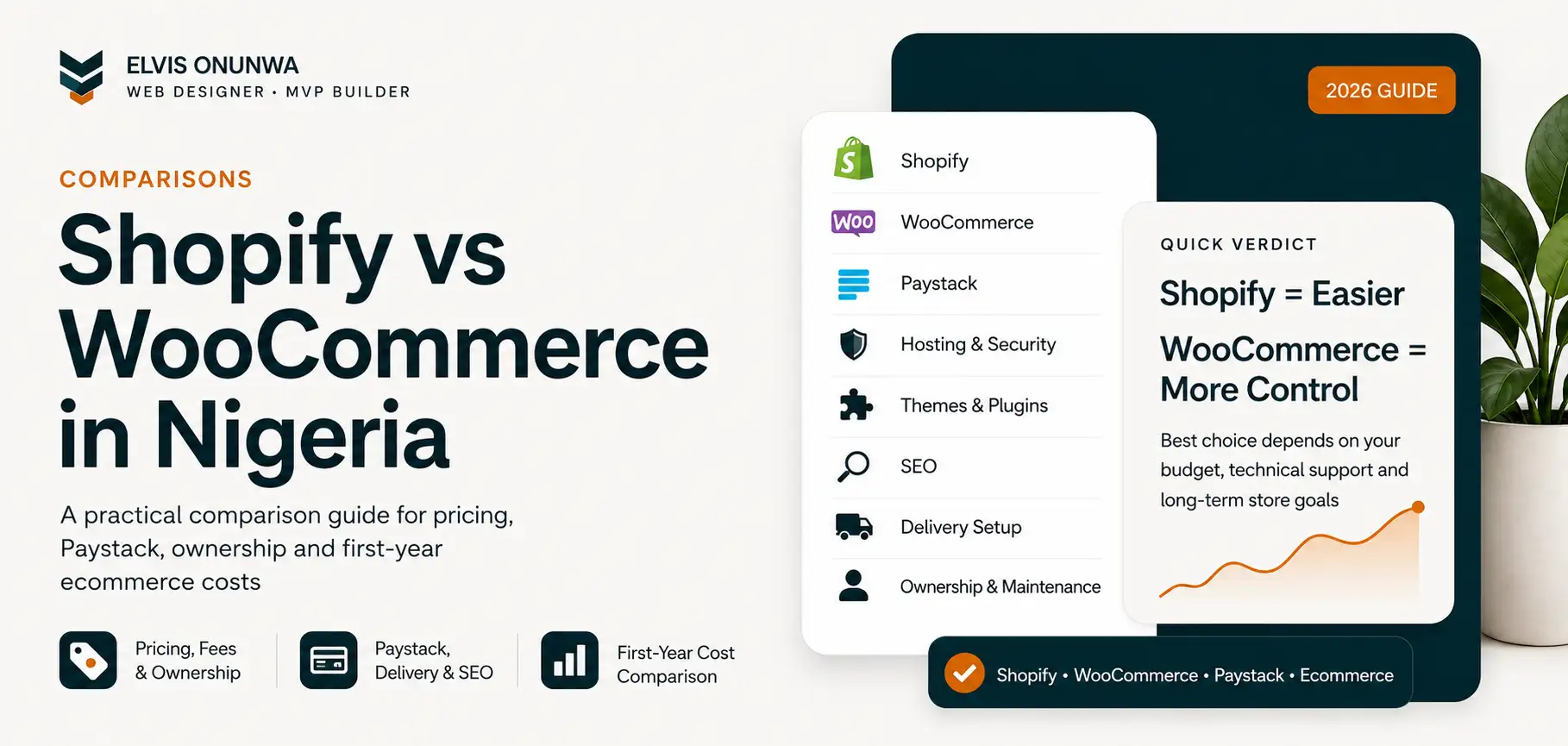
The practical answer to the Shopify vs WooCommerce Nigeria question is simple:
Choose Shopify when you want a stable, easier-to-manage online store and are comfortable paying recurring fees in US dollars. Choose WooCommerce when you want greater control, lower platform fees and more customisation—and you have a reliable developer or maintenance plan.
Neither platform is automatically better for every Nigerian business.
Shopify reduces the number of technical decisions you have to make. Hosting, security certificates, core updates and much of the infrastructure are handled by Shopify. WooCommerce gives you more freedom, but your hosting, plugins, backups, security and technical maintenance must be managed properly.
The more useful comparison is therefore not only:
Which platform has more features?
It is:
Which platform gives my Nigerian business the right balance of cost, control, reliability and technical responsibility?
This guide compares the platforms using realistic Nigerian costs, Paystack payments, naira budgeting, delivery setup, exchange-rate exposure, SEO, maintenance and first-year ownership costs.
Shopify vs WooCommerce Nigeria: Quick verdict
Your situation | Better starting choice |
|---|---|
You want the easiest platform to operate | Shopify |
You do not want to manage hosting or updates | Shopify |
You want maximum control over the website | WooCommerce |
You want to avoid an additional platform transaction fee | WooCommerce |
Your budget is mostly in naira | WooCommerce |
You have no developer after launch | Shopify |
You already have a WordPress website | WooCommerce |
You need unusual checkout or product workflows | WooCommerce |
You want a standard international retail store | Shopify |
You want strong blogging and content marketing flexibility | WooCommerce |
You have a large catalogue but standard retail operations | Shopify |
You have a complex catalogue and a technical team | WooCommerce |
You want to launch quickly with fewer technical decisions | Shopify |
The shortest honest verdict
Shopify is usually better for convenience. WooCommerce is usually better for control.
For a Nigerian merchant, however, payment fees and foreign-currency billing make the comparison more complicated. Nigeria is not currently listed among the countries supported by Shopify Payments, so Nigerian Shopify merchants generally need a third-party provider such as Paystack. Shopify may then charge its additional third-party transaction fee on top of the payment gateway’s normal processing charge.
WooCommerce does not charge an additional platform fee for using Paystack or another payment processor. You still pay the gateway’s processing charge, but WooCommerce does not take an extra percentage of the order.
Shopify vs WooCommerce comparison at a glance
Area | Shopify | WooCommerce |
Core platform | Hosted ecommerce platform | Open-source WordPress plugin |
Basic software cost | Monthly or annual subscription | Free |
Hosting | Included | Purchased separately |
SSL certificate | Included | Often included by host |
Payment platform fee | May apply with third-party gateways | No WooCommerce platform fee |
Paystack | Supported | Supported |
Ease of use | Easier for non-technical owners | Requires more configuration |
Maintenance | Mostly handled by Shopify | Owner or developer handles it |
Customisation | Strong, but within Shopify’s system | Very high |
Ownership and hosting control | Shopify hosts the platform | You choose the host and control the installation |
SEO | Strong built-in essentials | More flexible with WordPress tools |
Security responsibility | Much of the infrastructure is managed | Shared between owner, host and developer |
Exchange-rate exposure | High because subscriptions and many apps are billed in USD | Lower, but some themes and plugins are still billed in USD |
Migration | Possible, but store functionality may need rebuilding | Possible, but plugins and custom data require planning |
Best for | Convenience and standard retail | Control and custom requirements |
Shopify vs WooCommerce pricing in Nigeria
The platform advertised as “cheaper” is not always the platform with the lower total cost.
Shopify has a visible subscription price, but the final cost may include:
Store development
Shopify subscription
Domain name
Paid theme
Applications
Product uploads
Paystack processing fees
Shopify’s third-party transaction fee
Maintenance and developer support
Currency-conversion or international-card charges
WooCommerce is free to install, but the final cost may include:
WordPress and WooCommerce development
Hosting
Domain name
Theme
Premium plugins
Security
Backups
Performance optimisation
Product uploads
Paystack processing fees
Maintenance and developer support
For a broader breakdown beyond these two platforms, see the complete guide to ecommerce website cost in Nigeria.
Realistic first-year cost comparison in Naira
The following figures are planning ranges, not fixed market prices. They exclude inventory, product photography, advertising, staff salaries, delivery charges and transaction fees that depend on sales volume.
Store type | Shopify first-year estimate | WooCommerce first-year estimate |
Lean store with 20–50 products | ₦650,000–₦1.35 million | ₦550,000–₦1.2 million |
Professional retail store | ₦1.8 million–₦5 million | ₦1.1 million–₦3 million |
Advanced or highly customised store | ₦5 million–₦16 million+ | ₦3 million–₦10 million+ |
WooCommerce can cost less in the first year, but only when it is built on appropriate hosting and maintained correctly.
A neglected WooCommerce store can become expensive through downtime, plugin conflicts, malware, failed updates and repeated developer repairs. A Shopify store can also become expensive when it depends on several paid applications or processes enough sales for the third-party transaction fee to become significant.
Important exchange-rate assumption
Dollar examples in this guide use a planning rate of ₦1,600 to US$1.
This is not an exchange-rate prediction. Your bank, card provider, billing date, taxes and international-payment charges will determine the final naira amount.
Shopify subscription costs in Nigeria
Shopify’s Nigerian pricing page currently lists these rates:
Shopify plan | Paid monthly | Monthly equivalent when billed yearly | Approximate annual cost at ₦1,600/$ |
Basic | US$27/month | US$19/month | ₦364,800 yearly |
Grow | US$72/month | US$54/month | ₦1,036,800 yearly |
Advanced | US$399/month | US$299/month | ₦5,740,800 yearly |
Plus | From US$2,300/month | Contract dependent | From ₦44.16 million yearly |
The annual amount in the last column uses the lower annual-billing rate.
For example:
Basic paid yearly: US$19 × 12 = US$228
At ₦1,600 per dollar: approximately ₦364,800
Basic paid monthly: US$27 × 12 = US$324
At ₦1,600 per dollar: approximately ₦518,400
Shopify includes hosting, unlimited bandwidth and a TLS certificate with its plans. A separate hosting subscription is therefore not required.
For a more detailed breakdown of developer fees, applications, themes and setup, read the guide to Shopify development cost in Nigeria.
Shopify’s third-party payment-provider fee in Nigeria
This is one of the most important differences between Shopify and WooCommerce for a Nigerian business.
Shopify Payments is not currently available to businesses based in Nigeria. Nigerian merchants therefore commonly connect an external provider such as Paystack.
Shopify currently lists the following additional fees for third-party payment providers:
Plan | Shopify third-party provider fee |
Basic | 2% |
Grow | 1% |
Advanced | 0.6% |
Plus | Approximately 0.2%, subject to agreement |
This fee is separate from what Paystack charges to process the payment. Shopify’s published materials confirm that the third-party fee varies by plan.
Example: A store making ₦5 million monthly
Suppose your store processes ₦5 million in online sales every month through Paystack.
Plan | Additional Shopify fee per month | Approximate yearly fee |
Basic at 2% | ₦100,000 | ₦1.2 million |
Grow at 1% | ₦50,000 | ₦600,000 |
Advanced at 0.6% | ₦30,000 | ₦360,000 |
These figures do not include the Paystack processing fee.
This means that a growing Nigerian store should not choose a Shopify plan by looking only at the monthly subscription. The transaction volume may eventually make a higher plan or another platform more economical.
WooCommerce costs in Nigeria
WooCommerce is free, open-source software. It does not have a mandatory monthly platform subscription or revenue-sharing charge.
The real cost comes from the infrastructure and professional work required to build and maintain the store.
WooCommerce itself estimates that hosting for online stores can range widely depending on traffic and performance requirements. It also lists many official extensions between US$29 and US$299 per year.
A realistic Nigerian WooCommerce budget may include:
Cost item | Typical planning range |
WooCommerce software | Free |
Store development | ₦500,000–₦3.5 million+ |
Domain | ₦8,000–₦30,000 yearly |
Ecommerce hosting | ₦80,000–₦600,000+ yearly |
Theme | Free–₦250,000+ |
Premium plugins | ₦0–₦800,000+ yearly |
Paystack integration | Free plugin; developer setup may cost extra |
Security and backup tools | ₦0–₦300,000+ yearly |
Maintenance | ₦120,000–₦1.2 million+ yearly |
Product uploads | Depends on catalogue size and quality |
A basic WooCommerce store can operate with mostly free tools. A complex store may need paid extensions for subscriptions, bookings, product bundles, advanced filtering, shipping rules, multilingual content or wholesale pricing.
For a wider explanation of WordPress hosting, plugins, themes and maintenance, see the guide to WordPress website cost in Nigeria.
Shopify Paystack vs WooCommerce Paystack
Paystack supports integrations for both Shopify and WooCommerce. Its directory lists both platforms, and Paystack provides a Shopify setup process as well as a WooCommerce plugin.
Paystack currently charges Nigerian businesses:
Local transactions: 1.5% + ₦100
The ₦100 charge is waived for transactions below ₦2,500
Local transaction fees are capped at ₦2,000
International transactions: 3.9% + ₦100
No integration fee
No maintenance fee
Paystack on Shopify
Paystack can be installed from Shopify’s payment settings. Successful Paystack payments are automatically matched to the corresponding Shopify orders.
The advantage is a relatively simple setup and centralised order management.
The disadvantage is that the merchant may pay:
Paystack’s processing fee
Shopify’s third-party payment-provider fee
For a ₦100,000 local order:
Paystack fee: approximately ₦1,600
Shopify Basic fee at 2%: approximately ₦2,000
Combined deduction: approximately ₦3,600
This example excludes any taxes or other applicable charges.
Paystack’s Shopify integration also supports currency presentment, allowing a merchant to display and accept checkout payments in a selected supported currency even when the Shopify store has another base currency.
Paystack on WooCommerce
The WooCommerce Paystack extension does not have a monthly integration charge. You pay the normal Paystack transaction fee, but WooCommerce does not add a separate percentage because you selected Paystack.
The WooCommerce Marketplace describes the Paystack extension as having no setup fee, monthly fee or hidden platform cost.
Payment verdict
WooCommerce has the stronger cost advantage for Paystack.
Shopify still provides the easier overall operating environment, but the additional third-party payment fee should be included in every serious Shopify budget for Nigeria.
Ease of use for a non-technical store owner
Shopify is generally easier for a non-technical business owner.
The dashboard is built specifically for ecommerce. Products, orders, customers, discounts, reports and inventory are managed within one controlled system. Hosting and core platform updates happen behind the scenes.
WooCommerce is also manageable after a proper setup, but it sits inside WordPress. The owner may see separate areas for:
WordPress updates
WooCommerce updates
Plugin updates
Theme updates
Hosting
Backups
Security
Caching
Email delivery
Database optimisation
A trained owner can handle products and orders without difficulty. The technical side, however, should usually be managed by a developer or maintenance provider.
Ease-of-use verdict
Choose Shopify when you want fewer technical decisions after launch.
Choose WooCommerce when you are comfortable having a developer maintain the system or you already understand WordPress.
Developer dependence
Shopify reduces developer dependence for routine store management.
A store owner can usually:
Add products
Change prices
Create discounts
Manage orders
Update inventory
Edit basic pages
Change banners
Install applications
without contacting a developer.
You may still need a Shopify developer for:
Custom theme sections
Liquid development
Complex product filters
ERP integrations
Subscription systems
Wholesale features
Checkout customisation
Speed improvements
Application development
WooCommerce gives the store owner more control, but that freedom creates more technical responsibility.
You may need a WooCommerce developer for:
Hosting problems
Plugin conflicts
Failed updates
Checkout errors
Performance issues
Security incidents
Custom code
Database problems
Payment-webhook problems
Theme compatibility
WooCommerce’s own documentation recommends backing up the store and keeping WordPress, WooCommerce, themes, gateways and extensions updated for security and compatibility.
Product catalogue and inventory management
Both Shopify and WooCommerce can handle small and large product catalogues.
Shopify includes unlimited products across its main plans, while the Basic plan currently includes up to 10 inventory locations. Its managed infrastructure makes it attractive for businesses that expect catalogue or order volume to grow without wanting to manage servers.
WooCommerce also supports unlimited products and orders at the software level. Its real capacity depends on:
Hosting quality
Database health
Number of product variations
Theme quality
Plugin quality
Caching
Image optimisation
Search and filtering setup
Traffic volume
WooCommerce can scale to large stores, but the hosting and technical architecture must scale with it. WooCommerce’s own scaling guidance notes that hosting packages are often designed around different traffic volumes and that scalability depends on maintaining performance as products, customers and orders increase.
Catalogue verdict
For a large but conventional retail catalogue, Shopify is often easier to operate.
For a catalogue requiring unusual product relationships, custom fields, complex filtering, specialised pricing or custom data structures, WooCommerce may provide greater flexibility.
Nigerian delivery and shipping setup
An ecommerce website is incomplete if customers cannot understand how their orders will reach them.
Both platforms can support:
Flat delivery fees
Free delivery
State or regional delivery zones
Weight-based rates
Price-based rates
Local pickup
Same-city delivery
Nationwide courier services
Third-party shipping integrations
Shopify allows merchants to create shipping zones, flat rates, free-shipping rules and local delivery options. Some live carrier-rate features depend on the selected plan or external applications.
WooCommerce includes shipping zones and supports extensions for more complex rules.
Nigerian shipping platforms such as Shipbubble advertise integrations with both Shopify and WooCommerce, allowing merchants to import orders, compare courier services, generate tracking information and manage fulfilment.
Shipping verdict
Neither platform wins automatically.
Shopify may be easier when a suitable shipping application already supports your workflow.
WooCommerce may be better when your delivery rules require extensive customisation.
Before choosing either platform, document:
Where you deliver
Which courier companies you use
Whether customers pay delivery before checkout
Whether delivery is based on state, city, weight or distance
Whether you offer pickup
How failed deliveries are handled
How customers receive tracking information
SEO capabilities
Both Shopify and WooCommerce can rank well on Google.
Shopify includes important SEO controls such as editable title tags, meta descriptions, URLs and redirects. It also handles several technical elements automatically.
WooCommerce benefits from the wider WordPress content-management system. It gives developers and marketers more control over:
Blog architecture
Category pages
Product schema
Internal linking
URL structures
Landing pages
Content templates
Structured data
SEO plugins
Custom taxonomies
Programmatic content
Shopify SEO advantages
Important technical basics are handled automatically
Products and collections are easy to optimise
Redirect management is built in
Hosting performance is more consistent
Fewer plugins are required
International-market tools are available
Shopify SEO limitations
Some URL structures are controlled by Shopify
Advanced content architecture can require custom development
Applications can add scripts that affect performance
Some international features require Shopify Payments
Complex schema or technical SEO changes may require theme code
WooCommerce SEO advantages
Strong blogging and editorial tools
Greater URL and content control
Large selection of SEO tools
Flexible category and landing-page structures
Easier integration between informational and commercial content
More control over structured data and templates
WooCommerce SEO limitations
Poor hosting can reduce speed
Too many plugins can create technical problems
Duplicate category or filter pages must be controlled
The owner is responsible for updates and redirects
A badly configured theme can undermine performance
SEO verdict
WooCommerce has the higher customisation ceiling.
Shopify provides a cleaner, more controlled starting point.
The platform matters, but product descriptions, category structure, useful content, internal linking, speed, reputation and backlinks will matter more than the platform name alone.
Store speed and performance
Shopify has a major advantage in infrastructure simplicity.
Hosting and content delivery are included, so the merchant does not need to configure a server, database, caching layer or SSL certificate. However, a Shopify store can still become slow when the theme is poorly built or too many applications load scripts on every page.
WooCommerce speed depends heavily on the quality of the build.
A fast WooCommerce store usually requires:
Suitable ecommerce hosting
Server-side caching
Image compression
A lightweight theme
Careful plugin selection
Database maintenance
A content delivery network
Proper product-query optimisation
Staging tests before major updates
WooCommerce’s developer guidance recommends server-side caching and other infrastructure-level performance work for stores that require better speed.
Performance verdict
Shopify offers more predictable performance with less technical work.
WooCommerce can be extremely fast, but performance must be engineered and maintained.
Security and maintenance
Shopify includes secure hosting and is certified as Level 1 PCI DSS compliant. Shopify states that this compliance applies by default to stores powered by its platform.
This does not remove every responsibility from the merchant. Store owners must still:
Use strong passwords
Enable two-factor authentication
Control staff permissions
Review applications
Protect customer data
Recognise phishing attempts
Follow privacy and consumer-protection requirements
With WooCommerce, security responsibility is more distributed.
The store owner, developer and hosting provider must manage:
WordPress updates
WooCommerce updates
Plugin and theme updates
Backups
Malware protection
Firewalls
User permissions
Database security
Server configuration
Failed-payment investigations
Plugin vulnerabilities
WordPress documentation recommends keeping plugins and themes updated and maintaining recent backups before applying changes.
Security verdict
Shopify is easier for a business without technical support.
WooCommerce can be secure, but security must be actively managed.
Customisation and ownership
WooCommerce offers deeper ownership and customisation.
You choose:
The hosting provider
The database
The theme
The plugins
The source code
The payment gateways
The email provider
The backup system
The analytics tools
The deployment process
WooCommerce describes itself as a free, open-source platform with no platform fee or revenue share.
Shopify gives you ownership of your business content and customer relationship, but the commerce system runs on Shopify’s hosted platform. You customise the store through themes, applications, APIs and Shopify’s available settings.
This is not automatically a disadvantage.
Many businesses prefer a controlled platform because they do not want to own the responsibility of running ecommerce infrastructure.
Ownership verdict
Choose WooCommerce when control over the technical stack is a business requirement.
Choose Shopify when you would rather pay for a managed system than operate the infrastructure yourself.
Exchange-rate risk
Shopify creates more direct exchange-rate exposure for Nigerian businesses because:
The platform subscription is billed in US dollars
Many paid themes are billed in US dollars
Many applications are billed monthly in US dollars
Some developers quote custom Shopify work partly in dollars
International-card charges may apply
Shopify’s help centre states that countries without supported local-currency billing are billed in USD. Nigeria is not included in its current local-currency billing list.
WooCommerce reduces, but does not completely remove, exchange-rate risk.
You may still pay in dollars for:
Premium plugins
Premium themes
International hosting
Security tools
Email services
Content delivery networks
Developer licences
However, you can pay a Nigerian hosting company and local developer in naira, and the platform does not impose a mandatory dollar subscription.
Exchange-rate verdict
WooCommerce is generally easier for a business that earns only in naira and wants fewer compulsory dollar expenses.
Shopify may be easier for a business that already earns foreign currency or can comfortably budget for recurring international charges.
Shopify vs WooCommerce for small stores
For a small store with 10 to 50 products, the decision depends on who will manage it.
Choose Shopify when:
The owner wants to manage the store personally
The products follow a normal retail structure
The business can afford the subscription
Fast launch is more important than deep customisation
The owner does not have a dependable WordPress developer
The store is expected to grow quickly
Operational simplicity matters more than the lowest possible fee
Choose WooCommerce when:
The business already has a WordPress website
The owner wants to minimise recurring platform costs
The store needs only a few ecommerce features
A developer will maintain the website
Content marketing is central to the sales strategy
The business wants more control over the website
The extra Shopify transaction fee would materially affect margins
Small-store verdict
Shopify is easier.
WooCommerce can be more economical.
Shopify vs WooCommerce for large catalogues
A large catalogue does not automatically mean WooCommerce or Shopify is better.
Shopify may be better when:
The catalogue has standard products and variations
The business needs stable infrastructure
Several staff members manage inventory
The company sells through multiple channels
The business wants fewer server concerns
The store uses established applications and integrations
WooCommerce may be better when:
Products require custom fields or unusual relationships
The catalogue needs advanced filtering
There are complex pricing or wholesale rules
The business has an internal technical team
Product content is deeply connected to editorial content
The store needs custom database or integration work
Large-catalogue verdict
Shopify is often better for operational simplicity.
WooCommerce is often better for unusual catalogue requirements.
Shopify vs WooCommerce for international selling
Shopify has strong tools for international commerce, including markets, translations, regional pricing and international domains.
However, some local-currency and international-market features require Shopify Payments. Because Shopify Payments is not currently available to Nigerian businesses, merchants should confirm exactly which market features will work with Paystack before committing to a build. Shopify’s pricing page marks several local-currency and local-payment features as requiring Shopify Payments.
WooCommerce gives merchants more control over currencies, domains, translations, taxes and payment processors, but these features may require several plugins and careful development.
International-selling verdict
Shopify is generally easier for a standard international retail operation.
WooCommerce may be more suitable when the international setup requires custom currencies, regional rules or payment arrangements that do not fit Shopify’s standard system.
Migration difficulty
Moving from Shopify to WooCommerce—or WooCommerce to Shopify—is possible, but it is not a one-click decision.
Products, customers and orders can usually be exported or transferred. The difficult parts are often:
Product variations
Customer passwords
Subscriptions
Gift cards
Reviews
Discount rules
Custom fields
Application data
Search rankings
URL redirects
Theme design
Checkout customisation
Order history
Inventory integrations
Shopify provides migration guidance and redirect tools, but custom functionality normally has to be recreated for the new platform.
Before migrating, create a written inventory of:
Data that must move
Features that must be rebuilt
URLs that need redirects
Integrations that need replacement
Historical records that must be preserved
Downtime that the business can tolerate
Migration verdict
Choose a platform you can reasonably operate for at least the next three to five years.
Migration should not be treated as an easy escape from poor planning.
Three sample Nigerian store budgets
These are illustrative budgets, not quotations.
Budget 1: New fashion store with 30 products
Requirements:
Free or affordable theme
30 product uploads
Size and colour variations
Paystack
Lagos and nationwide delivery rates
WhatsApp support
Basic SEO
Store-owner training
Cost area | Shopify | WooCommerce |
Development and configuration | ₦450,000 | ₦500,000 |
Subscription or hosting | ₦364,800 | ₦100,000 |
Domain | ₦15,000 | ₦15,000 |
Theme and plugins/apps | ₦60,000 | ₦80,000 |
Product preparation and uploads | ₦120,000 | ₦120,000 |
First-year support | ₦120,000 | ₦180,000 |
Illustrative total | ₦1,129,800 | ₦995,000 |
Better choice: WooCommerce for lower cost; Shopify for easier management.
Budget 2: Growing beauty or electronics store with 250 products
Requirements:
Customised design
Product filters
Inventory tracking
Promotional discounts
Delivery integration
Analytics
Email marketing
Product migration
Ongoing support
Cost area | Shopify | WooCommerce |
Design and development | ₦900,000 | ₦1.1 million |
Subscription or hosting | ₦364,800 | ₦240,000 |
Theme and applications/plugins | ₦550,000 | ₦350,000 |
Product migration and integrations | ₦450,000 | ₦450,000 |
Support and maintenance | ₦300,000 | ₦420,000 |
Illustrative total | ₦2,564,800 | ₦2.56 million |
The first-year totals are almost identical.
The deciding factor should therefore be whether the business values Shopify’s convenience or WooCommerce’s control.
Budget 3: International retail brand
Requirements:
1,000 products
International checkout
Multiple regions
Advanced search and filters
Inventory integration
Customer accounts
Email automation
Product migration
Dedicated support
Cost area | Shopify | WooCommerce |
Design and development | ₦2 million | ₦2.5 million |
Platform or hosting | ₦1,036,800 on Grow | ₦600,000 |
Themes, apps or plugins | ₦600,000 | ₦700,000 |
Migration and integrations | ₦700,000 | ₦700,000 |
Support and maintenance | ₦600,000 | ₦900,000 |
Illustrative total | ₦4,936,800 | ₦5.4 million |
This example shows why WooCommerce is not always cheaper.
At a larger scale, stronger hosting, development and maintenance can cost more than Shopify’s managed platform. However, Shopify’s third-party transaction fee must still be added according to the store’s sales volume.
Decision checklist: Shopify or WooCommerce in Nigeria?
Answer these questions before choosing.
Choose Shopify when most answers are yes
Do you want to launch quickly?
Will a non-technical owner manage the store?
Can you pay recurring dollar subscriptions?
Do your products follow a normal retail structure?
Do you prefer predictable infrastructure?
Do you want hosting and core security handled for you?
Are you comfortable using applications for additional features?
Is convenience more important than maximum control?
Can your margins absorb Shopify’s third-party payment fee?
Choose WooCommerce when most answers are yes
Do you want full control over your website?
Do you already use WordPress?
Do you want to avoid Shopify’s additional payment-provider fee?
Is most of your budget in naira?
Do you need custom product, checkout or pricing logic?
Is content marketing important to your strategy?
Do you have a developer or maintenance provider?
Do you want to choose your own hosting?
Are you comfortable managing updates and backups?
Do you need unusual integrations?
Final verdict: Which is better in Nigeria?
For most Nigerian businesses, the best choice depends on operational responsibility rather than the number of features.
Shopify is better when the business wants a managed ecommerce system, faster setup and easier daily operation.
WooCommerce is better when the business wants control, customisation, strong content tools and fewer compulsory platform fees.
A small Nigerian store should not choose WooCommerce simply because the software is free. Hosting, maintenance and professional development still cost money.
A Nigerian store should also not choose Shopify simply because it looks easier. The dollar subscription, paid applications and additional third-party transaction fee can become significant as sales grow.
The best platform is the one that matches:
Your current budget
Your expected sales volume
Your profit margin
Your catalogue complexity
Your technical support
Your payment requirements
Your delivery process
Your international plans
Your willingness to maintain the system
My practical recommendation
Choose Shopify for a straightforward product business that wants stability, speed and simpler management.
Choose WooCommerce for a content-led business, a naira-sensitive small store or a company that needs greater control and custom functionality.
For a serious ecommerce project, calculate the complete first-year and three-year cost before choosing either platform.
Shopify and WooCommerce development services
I help Nigerian businesses plan and build ecommerce stores based on how the business will actually operate—not only on which platform is popular.
My Shopify development service can include:
Store planning
Theme setup and customisation
Product and collection structure
Paystack setup
Shipping configuration
Product uploads
Search-engine setup
Analytics
Mobile optimisation
Store-owner training
Post-launch support
My WordPress and WooCommerce development service can include:
Ecommerce strategy
WooCommerce development
Hosting configuration
Custom store design
Paystack integration
Product filters and variations
Shipping zones
Security and backups
Performance optimisation
Technical SEO
Maintenance planning
Not sure which platform fits your catalogue, budget or business model? Contact me to discuss your ecommerce project.
Frequently asked questions
Is Shopify better than WooCommerce in Nigeria?
Shopify is better for Nigerian businesses that prioritise ease of use, managed hosting and simpler maintenance. WooCommerce is better for businesses that want greater control, customisation and lower platform payment fees.
Which is cheaper in Nigeria: Shopify or WooCommerce?
WooCommerce can be cheaper because the core software is free and it does not charge an additional percentage for using Paystack. However, hosting, development and maintenance must be included. Shopify can offer better value when avoiding technical problems and developer dependence is more important than paying the lowest platform fee.
Can I use Paystack with Shopify in Nigeria?
Yes. Paystack provides a Shopify integration that can be installed through Shopify’s payment settings. Nigerian merchants should remember that Shopify may charge an additional third-party payment-provider fee on top of Paystack’s processing charge.
Can I use Paystack with WooCommerce?
Yes. Paystack provides a WooCommerce plugin. WooCommerce does not add a separate platform transaction fee, although Paystack’s normal payment-processing fees still apply.
Does Shopify accept naira?
A Shopify store can display and process naira payments through a supported third-party provider such as Paystack. Paystack’s Shopify integration also supports currency presentment. The Shopify subscription itself is generally billed to Nigerian merchants in US dollars.
Does WooCommerce charge monthly fees?
WooCommerce does not charge a mandatory monthly platform fee. You still need to pay for hosting, a domain and any premium themes, plugins, security services or maintenance your store uses.
Is WooCommerce difficult to maintain?
WooCommerce requires more maintenance than Shopify. WordPress, WooCommerce, themes and plugins must be updated, while backups, security, hosting and performance need to be monitored.
Is Shopify good for a small Nigerian business?
Shopify can be good for a small Nigerian product business that wants an easy-to-manage store and can afford the recurring dollar subscription and transaction costs. A business with very small margins should calculate the additional payment-provider fee carefully.
Is WooCommerce good for a large online store?
Yes. WooCommerce can support large catalogues and order volumes when it is built on suitable hosting and maintained by an experienced technical team. A poorly configured WooCommerce store may struggle as its catalogue and traffic grow.
Which platform is better for SEO?
Both platforms can rank well. Shopify provides the essential SEO controls in a managed environment. WooCommerce provides more flexibility through WordPress, especially for blogging, landing pages, custom schemas and complex content structures.
Which platform is better for international selling?
Shopify is generally easier for conventional international retail. However, Nigerian merchants should confirm which international features work without Shopify Payments. WooCommerce provides more control but may require additional plugins and technical setup.
Can I move from WooCommerce to Shopify later?
Yes, but products, customers, orders, URLs, integrations and custom functionality must be migrated carefully. Some features may need to be rebuilt.
Can I move from Shopify to WooCommerce?
Yes. Store data can be exported, but the Shopify theme, applications and custom functionality do not automatically transfer. The new WooCommerce system must be designed and tested before the Shopify store is closed.
What is the best ecommerce platform in Nigeria?
There is no single best platform for every business. Shopify is one of the best choices for managed ecommerce, while WooCommerce is one of the best choices for control and customisation. The correct platform depends on budget, sales volume, margins, technical support and operational requirements.