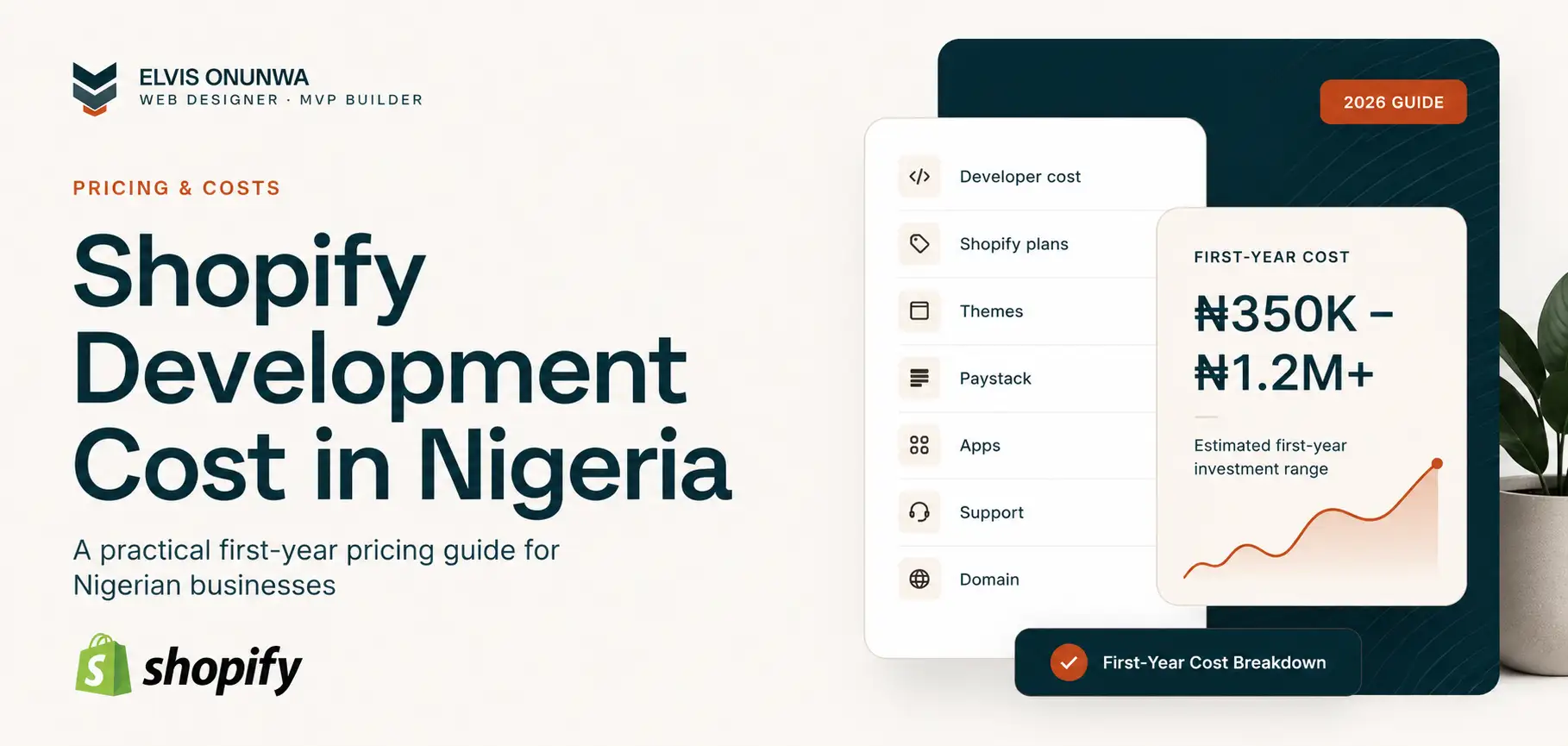
A Shopify store in Nigeria can cost a few hundred thousand naira to launch or several million naira to build properly.
The range is wide because “Shopify development” can mean very different things.
For one business, it means installing a theme, connecting Paystack and uploading 30 products. For another, it means migrating hundreds of products, rebuilding the theme, connecting inventory software, designing custom collection logic and supporting a high-volume retail operation.
The useful question is therefore not simply:
How much does Shopify cost?
It is:
What will this Shopify store cost to build, operate and sell through during the first year?
That second question exposes the costs that cheap quotations often leave out.
Prices and platform fees checked on September 5, 2026. Shopify and Paystack pricing can change, and Shopify bills Nigerian merchants in a way that can expose the final naira amount to foreign-exchange and card-provider differences. Confirm current pricing before paying.
Shopify development cost in Nigeria at a glance
There is no regulated Nigerian Shopify-development price. Current published local offers vary by scope.
A practical planning view is:
| Project level | What it usually means | Planning range |
|---|---|---|
| DIY / assisted setup | Account configuration, theme setup, payment connection and guidance | ₦0–₦250,000 |
| Basic theme-based store | Free or existing theme, navigation, policies, Paystack, small catalogue | ₦300,000–₦600,000 |
| Professional retail store | Better merchandising, custom sections, larger catalogue, analytics, training | ₦600,000–₦1.5 million |
| Custom Shopify development | Liquid/theme development, complex filters, migrations, integrations | ₦1.5 million–₦4 million+ |
| Enterprise / headless / complex integration | Custom storefront, ERP, wholesale logic, automation, large migration | Several million naira upward |
These are planning bands, not fixed market prices.
Current Nigerian provider examples support the broad shape of that market: WebsiteDesigner.ng publishes Shopify packages from ₦400,000, while Raspib Technology publishes Shopify setup ranges from ₦300,000 to ₦3 million depending on complexity.
The biggest pricing mistake is comparing the developer fee alone.
The real first-year Shopify cost has six layers
A useful Shopify budget separates these six costs:
- Store design and development
- Shopify subscription
- Payment processing and Shopify transaction fees
- Theme and app subscriptions
- Catalogue, photography and content work
- Ongoing support and growth work
A quote may include some of these and exclude the rest.
If one developer quotes ₦450,000 and another quotes ₦900,000, the cheaper offer is not automatically better value. The first may cover theme installation and 20 products; the second may include catalogue cleanup, custom sections, conversion design, analytics, training and post-launch support.
Current Shopify plan prices for Nigeria
Shopify’s official Nigeria pricing page currently lists:
| Plan | Paid yearly | Paid monthly | Third-party payment-provider fee |
|---|---|---|---|
| Basic | US$19/month | US$27/month | 2% |
| Grow | US$54/month | US$72/month | 1% |
| Advanced | US$299/month | US$399/month | 0.6% |
| Plus | From US$2,300/month | Contract dependent | Plan dependent |
Source: Shopify Nigeria pricing.
Shopify currently advertises a three-day free trial followed by an introductory US$1/month period for eligible new stores. Treat introductory offers as temporary acquisition pricing, not your long-term operating cost.
What does Basic cost in naira?
There is no reliable permanent naira number because the bill is denominated in dollars and the conversion can vary with your card provider and the exchange rate on the billing date.
That is why I would not build a 12-month store budget around a statement such as “Shopify Basic is ₦48,000 per month.” It may be near the actual charge at one exchange rate and wrong a few months later.
A safer budget keeps the subscription in dollars and converts it using the exchange rate your business is actually paying when the invoice is due.
Shopify hosting is already included
A normal Shopify store does not need a separate conventional web-hosting plan.
Your Shopify subscription includes the hosted commerce platform and SSL. That removes a category of server-maintenance responsibility that a self-hosted WooCommerce store would otherwise need to manage.
You still need to pay separately for things such as:
- your domain;
- paid themes;
- paid apps;
- custom development;
- product photography and copy;
- payment processing;
- email or other business software;
- maintenance, merchandising and growth work.
If you are comparing the economics of different hosting models, see my web hosting cost in Nigeria guide.
Paystack + Shopify: the cost most Nigerian merchants need to model
Paystack provides an official Shopify integration and setup process. A merchant can add Paystack from Shopify’s payment settings, install the Paystack app, enter API keys and activate the payment method. See Paystack’s Shopify setup guide.
Paystack’s current Nigerian pricing is:
- Local transactions: 1.5% + ₦100
- the ₦100 component is waived below ₦2,500;
- local transaction fees are capped at ₦2,000;
- international Mastercard/Visa/Verve transactions: 3.9% + ₦100;
- zero Paystack integration fee;
- zero Paystack maintenance fee.
Source: Paystack pricing.
The important detail is that Paystack’s processing fee may not be the only percentage cost.
When you use a third-party payment provider, Shopify can charge its own third-party transaction fee. On Shopify Nigeria, that is currently 2% on Basic, 1% on Grow and 0.6% on Advanced.
For a Nigerian merchant on Basic using Paystack, the simplified local-payment cost is therefore:
Paystack processing fee + Shopify’s 2% third-party-provider fee
That can materially affect margins in businesses selling low-margin products.
Example: what the fees look like on a ₦100,000 order
For a ₦100,000 local transaction processed by Paystack:
- Paystack: 1.5% of ₦100,000 + ₦100 = ₦1,600
- Shopify Basic third-party fee at 2% = ₦2,000
- simplified combined deduction = ₦3,600
This example excludes any other taxes, refunds, chargeback costs, app fees or business expenses.
The point is not that Shopify is “too expensive.” The point is that payment economics should be calculated before launch, especially when your gross margin is thin.
When Grow can become cheaper than Basic
This is one of the more useful calculations for a growing Nigerian store.
On annual billing:
- Basic: US$19/month with a 2% third-party-provider fee
- Grow: US$54/month with a 1% fee
- subscription difference: US$35/month
- transaction-fee saving: 1 percentage point
US$35 divided by 1% gives a break-even sales value of about US$3,500 per month in eligible third-party-provider sales.
At roughly that sales volume, the lower Shopify transaction fee can offset the higher Grow subscription before you even consider Grow’s additional staff and reporting features.
This does not remove Paystack’s processing fee. It only compares Shopify’s plan subscription and third-party-provider percentage.
Use your own actual sales and exchange-rate assumptions before upgrading.
Free theme or paid theme?
A common first-store mistake is buying a premium theme before the business understands what customers actually need.
A free Shopify theme can be enough when:
- you are launching your first store;
- your catalogue is straightforward;
- your product photography is strong;
- you do not need unusual product logic;
- the priority is validating demand quickly.
A paid theme becomes useful when its built-in features remove development work you would otherwise pay someone to recreate.
Examples include:
- stronger collection filtering;
- promotional sections;
- mega menus;
- product swatches;
- sticky add-to-cart controls;
- richer product information layouts;
- store-locator or age-gating features.
The correct comparison is not free theme versus expensive theme.
It is theme cost versus the development hours the theme saves.
Shopify apps can quietly become the largest recurring cost
Apps are easy to install, which makes them easy to accumulate.
A store might add separate apps for:
- reviews;
- bundles;
- WhatsApp chat;
- email marketing;
- search and filtering;
- loyalty;
- subscriptions;
- pre-orders;
- invoices;
- delivery;
- analytics;
- affiliate tracking.
Five US$20/month apps are already US$1,200 per year.
Before installing another app, ask:
- Does Shopify or the theme already do this?
- Is the feature actually important to conversion or operations?
- Is the app priced by orders, contacts, users or usage?
- Will removing the app later break store content or workflows?
- Can one better app replace two weaker ones?
App discipline is part of cost control.
Product uploads are not just data entry
The catalogue can be one of the most underestimated parts of a Shopify project.
A developer cannot produce a strong store from weak source material.
For each product, somebody may need to prepare:
- product name;
- description;
- price;
- compare-at price;
- SKU;
- inventory quantity;
- size and colour variants;
- weight;
- collection assignment;
- photographs;
- image alt text;
- SEO title and description;
- shipping information.
If you have 300 products and the information is scattered across WhatsApp chats, spreadsheets and supplier catalogues, catalogue preparation can consume more project time than the theme itself.
When comparing Shopify quotations, ask exactly how many products are included and whether the fee covers data cleanup or only upload.
What AI-assisted development can reduce — and what it cannot
AI-assisted development can make Shopify work faster in useful ways.
I use AI-assisted tools in product and web-development workflows to help with things such as:
- drafting implementation plans;
- generating repetitive code scaffolding;
- troubleshooting theme code;
- writing test cases;
- documenting changes;
- restructuring product or content data;
- reviewing implementation details.
That can reduce time spent on repetitive execution.
But it does not remove the need to decide:
- what the product catalogue should look like;
- how discounts and variants should behave;
- how payments are reconciled;
- what happens after a failed payment;
- how delivery rules map to real operations;
- which apps can be trusted with store data;
- whether a theme change breaks conversion-critical pages;
- who owns and tests the final release.
For founders, that distinction matters. AI can compress implementation. It does not automatically simplify the business rules.
If your product is closer to a software platform than a normal online store, read my MVP development cost guide before forcing complex SaaS logic into Shopify.
Sample first-year Shopify budgets
These examples are intentionally broad because the naira cost of the Shopify subscription changes with foreign exchange.
Lean launch
A new brand with 20–40 products might budget for:
- ₦300,000–₦600,000 theme-based setup;
- Basic Shopify subscription;
- free theme;
- domain;
- minimal paid apps;
- product preparation;
- Paystack processing and Shopify transaction fees as sales occur.
This is the sensible place to start when the store is still proving demand.
Professional retail store
An established brand with a larger catalogue may add:
- ₦600,000–₦1.5 million design/development;
- stronger merchandising and custom sections;
- paid theme if justified;
- several paid apps;
- analytics and tracking;
- migration or catalogue cleanup;
- ongoing optimisation and support.
Custom / high-volume store
A larger operation can move into several-million-naira development because the project may involve:
- complex integrations;
- ERP or inventory systems;
- wholesale logic;
- custom theme development;
- internationalisation;
- large migrations;
- custom applications;
- headless storefronts;
- higher support requirements.
At that stage, the business should model the store as operational infrastructure, not simply a website.
Shopify vs WooCommerce: which has the lower total cost?
Neither wins automatically.
Shopify usually gives you:
- managed hosting;
- less server administration;
- a tightly integrated ecommerce admin;
- a large app and theme ecosystem.
WooCommerce usually gives you:
- more hosting control;
- no Shopify subscription;
- no Shopify third-party-provider percentage;
- deeper WordPress-level ownership;
- more responsibility for updates, hosting, backups and plugin compatibility.
A cheap WooCommerce build with poor hosting and no maintenance can become expensive operationally. A Shopify store overloaded with paid apps and transaction fees can also become expensive.
For the full Nigeria-specific comparison, read Shopify vs WooCommerce for Nigerian businesses.
Questions to ask a Shopify developer before accepting a quote
Ask these before comparing prices:
- How many products and variants are included?
- Is catalogue cleanup included or only product upload?
- Is the theme free, paid or custom?
- Who buys and owns the theme licence?
- Is Paystack setup and live-payment testing included?
- Are shipping zones and delivery rules included?
- Which paid apps are required and what will they cost yearly?
- Is analytics and Search Console setup included?
- Are redirects handled if I am migrating an existing store?
- What post-launch support is included?
- Who owns the domain, Shopify account and third-party accounts?
- What work will be billed separately after launch?
A strong Shopify quotation should make those answers visible.
Final answer: how much should you budget?
For a straightforward Nigerian Shopify launch, several hundred thousand naira in development cost is realistic. For a professionally designed store with a larger catalogue, custom sections and stronger operations, the project can move beyond ₦1 million. Complex integrations and enterprise requirements can push the development budget into several millions.
But the developer quote is only the beginning.
Your real cost is:
development + Shopify subscription + payment fees + apps + theme + catalogue work + support + growth.
That is the number to compare against expected sales and margin.
If the business is still testing whether customers will buy, keep the first version lean. If the store already has demand and operational complexity, spend more where it removes friction, reduces manual work or improves conversion.
For a broader platform-neutral budget, see my ecommerce website cost in Nigeria guide. If you need help deciding what should be built now versus later, tell me about the project.