Elvis Onunwa

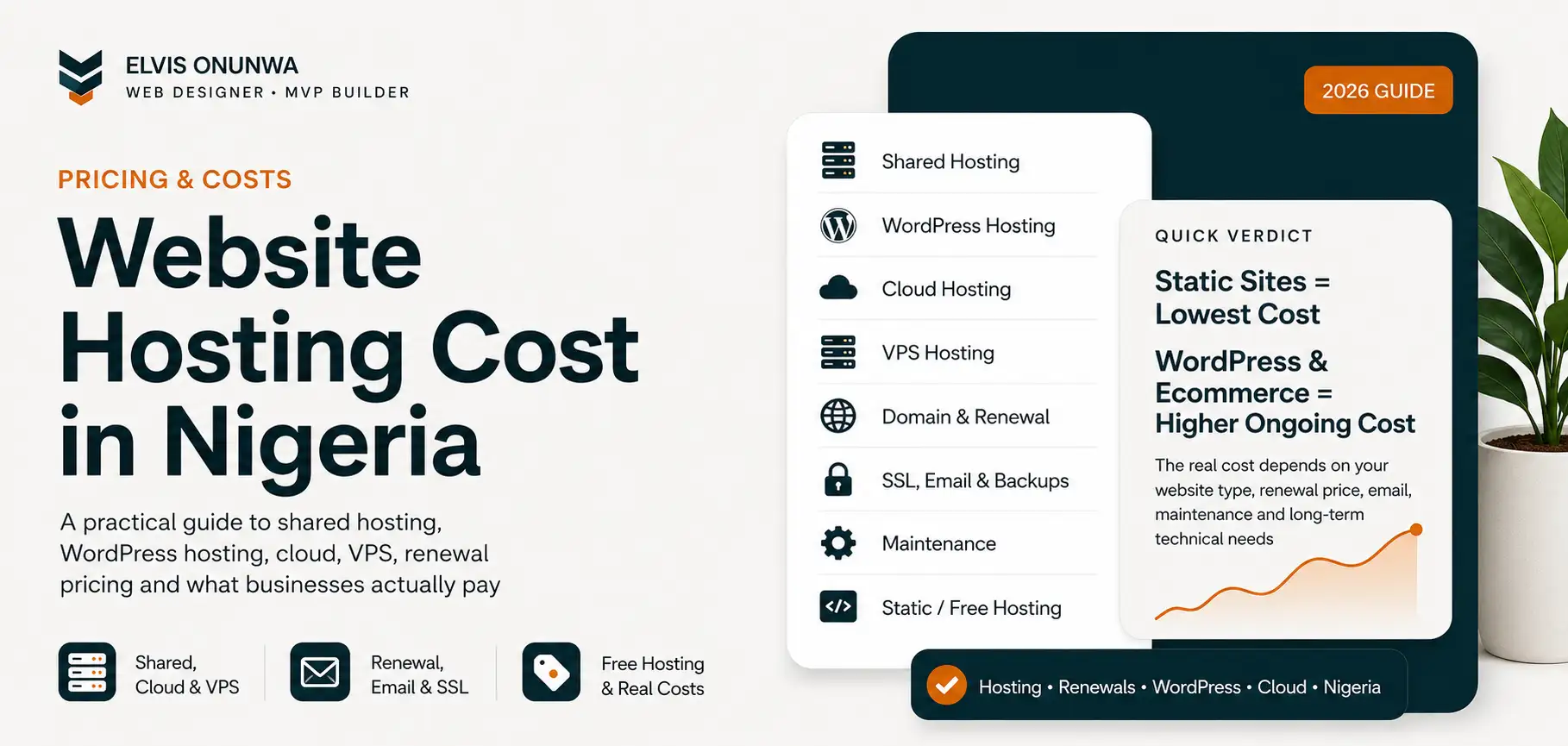
Website Hosting Cost in Nigeria (2026 Price Guide)

Website hosting in Nigeria costs ₦0 to millions yearly. Compare shared, WordPress, cloud, VPS, renewal, email, backups and free hosting.

Article

The website hosting cost in Nigeria can range from ₦0 per year for a properly built static business website to more than ₦5 million per year for dedicated server infrastructure .

For most Nigerian businesses, a realistic annual hosting budget falls between ₦15,000 and ₦150,000 for a small informational or WordPress website. Ecommerce websites, high-traffic platforms and business applications can require ₦250,000 to several million naira per year , depending on performance, security, storage and technical support.

The lowest advertised price is rarely the complete cost.

A hosting company may promote a heavily discounted first-year plan while showing the real renewal price only at checkout or inside the billing dashboard. Email, backups, SSL, malware protection, migrations and technical support may also be charged separately.

This guide explains what Nigerian businesses actually pay to keep a website online in 2026, not merely the cheapest price displayed on a hosting company’s homepage.

Pricing reviewed on 23 July 2026. Hosting plans and exchange rates can change, so confirm the current renewal amount before purchasing.

Website hosting cost in Nigeria at a glance

Here is a practical overview of the annual website hosting cost for different types of websites.

Hosting option

Typical annual hosting budget

Suitable for

Static website on Cloudflare Pages

₦0

Business websites, portfolios and landing pages without a database

Entry-level shared hosting

₦15,000–₦60,000

Small blogs and low-traffic websites

Business shared or WordPress hosting

₦50,000–₦150,000

Normal small-business WordPress websites

Managed WordPress hosting

₦240,000–₦1,000,000+

Important business, publishing and membership websites

Cloud hosting

₦360,000–₦1,200,000+

Growing websites, ecommerce and higher traffic

VPS hosting

₦240,000–₦1,500,000+

Web applications, busy stores and custom infrastructure

Dedicated server

₦3,800,000–₦5,600,000+

Large platforms and enterprise workloads

These ranges cover hosting infrastructure. They do not automatically include:

- Domain renewal

- Business email

- Website maintenance

- Premium plugins

- Content updates

- Technical support

- Malware removal

- Application development

- Database or file-storage charges

- Payment-processing charges

Current Nigerian examples show conventional shared-hosting plans around ₦8,700 to ₦45,000 per year. More powerful local cloud-hosting plans may cost ₦30,000 to ₦50,000 per month, while dedicated servers from one Nigerian provider currently start around ₦320,000 per month.

What is website hosting?

Website hosting is the infrastructure that stores your website and makes it available when someone enters your address into a browser.

A website may contain:

- Text

- Images

- Videos

- Code

- Databases

- Customer information

- Product records

- Order information

- Login accounts

- Uploaded documents

These files and systems must exist somewhere that stays connected to the internet.

Traditional websites are stored on servers operated by hosting companies. Newer static websites can be distributed across a global edge network without requiring the business to rent a conventional server.

The appropriate approach depends on what the website needs to do.

A five-page company website does not require the same infrastructure as a WooCommerce store processing hundreds of orders, a property-management platform storing tenancy records, or an MVP with logins, payments and dashboards.

Domain versus hosting: what does each payment cover?

A domain and hosting are related, but they are not the same thing.

Your domain

Your domain is the address people use to find your website.

Examples include:

- yourbusiness.com

- yourbusiness.com.ng

- yourbusiness.ng

You normally renew the domain once every year.

A practical domain-renewal budget in Nigeria is approximately:

Domain extension

Planning budget

. com.ng

₦5,500–₦12,000 yearly

.ng

₦13,500–₦25,000 yearly

.com

₦10,000–₦30,000 yearly

Premium domain

Variable

Registration promotions can make the first year look unusually cheap. The renewal price matters more because that is what the business will continue paying.

You can read my complete guide to domain registration and renewal pricing .

Your hosting

Hosting is where the website itself runs.

Depending on the website, the hosting may provide:

- File storage

- Server processing

- Database access

- Bandwidth

- Email accounts

- Backups

- SSL certificates

- Security tools

- A control panel

- Technical support

Buying a domain does not necessarily give you hosting. Buying hosting also does not always include a permanent domain.

When comparing the domain and hosting cost in Nigeria , check whether the advertised package includes a free domain only for the first year or continues covering its renewal.

Shared hosting cost in Nigeria

Shared hosting places several websites on the same server.

Those websites share resources such as:

- CPU

- Memory

- Storage

- Network capacity

- Database processing

This makes shared hosting inexpensive and easy to manage.

Current Nigerian provider examples include annual entry plans around ₦8,700, while another provider lists cPanel hosting from ₦15,000 to ₦45,000 per year.

A realistic shared-hosting budget is:

Shared-hosting level

Estimated annual cost

Very basic hosting

₦10,000–₦25,000

Small-business hosting

₦25,000–₦60,000

Higher-resource shared hosting

₦60,000–₦120,000+

Shared hosting is suitable for:

- Small company websites

- Personal portfolios

- Early-stage blogs

- Low-traffic WordPress websites

- Simple information websites

- Businesses that do not process many transactions

Shared hosting may become a problem when:

- Traffic begins to grow

- The website uses many WordPress plugins

- Several websites on the server compete for resources

- The store processes many simultaneous orders

- The website runs background jobs

- The business needs dependable performance

- The hosting company overcrowds its servers

Do not choose shared hosting based only on storage.

A plan offering “unlimited storage” can still have strict limits on memory, CPU usage, file counts, database connections, email sending and concurrent visitors.

Managed WordPress hosting cost in Nigeria

WordPress itself is free and open-source, but it requires hosting that supports its server and database requirements.

Many providers use the term “WordPress hosting” for normal shared hosting with WordPress pre-installed. True managed WordPress hosting usually includes more active technical support and infrastructure management.

It may provide:

- Automatic WordPress updates

- Daily backups

- Staging environments

- Malware monitoring

- WordPress-specific caching

- Improved server resources

- Expert migration support

- Performance monitoring

- Faster recovery after a problem

Current market examples vary significantly.

One Nigerian provider lists WordPress-focused infrastructure from ₦20,000 per month. International managed-cloud hosting can begin around US$11 per month, while premium managed WordPress providers may charge US$50 per month or more for one website.

A reasonable planning range is:

WordPress-hosting level

Estimated annual cost

WordPress on shared hosting

₦15,000–₦60,000

Quality business WordPress hosting

₦50,000–₦150,000

Managed WordPress hosting

₦240,000–₦1,000,000+

High-traffic managed WordPress

₦1,000,000+

A simple company website may not need premium managed hosting. However, paying more can be justified when the website is central to sales, publishing, bookings, membership access or customer operations.

For a complete view of design, themes, plugins, hosting and maintenance, read the WordPress website cost in Nigeria guide.

Cloud hosting cost in Nigeria

Cloud hosting distributes a website or application across cloud infrastructure rather than depending entirely on one conventional shared server.

It is commonly used when a business needs:

- More dependable performance

- Flexible scaling

- Better resource isolation

- Custom server configurations

- Stronger availability

- Support for applications and APIs

- Separate databases and storage

- Faster handling of traffic spikes

Cloud hosting can be self-managed or managed.

Self-managed cloud hosting

The business or developer manages:

- Server configuration

- Updates

- Security

- Backups

- Monitoring

- Deployments

- Recovery

Infrastructure may look inexpensive, but technical responsibility stays with the owner.

DigitalOcean virtual machines currently start at US$4 per month, while Amazon Lightsail Linux instances start from approximately US$5 per month for a plan with a public IPv4 address.

The basic server is only one part of the complete cost. You may still pay separately for:

- Managed databases

- File storage

- Outbound bandwidth

- Backups

- Monitoring

- Email delivery

- Security services

- Server administration

Managed cloud hosting

With managed cloud hosting, the provider handles more of the technical operation.

Current Nigerian examples include cloud plans at approximately:

Example cloud level

Listed monthly price

Annual equivalent

Entry cloud

₦30,000

₦360,000

Business cloud

₦40,000

₦480,000

Higher-resource cloud

₦50,000

₦600,000

These examples include resources such as dedicated CPU and memory, SSL, email and technical support.

Cloud hosting is not automatically better than shared hosting. It becomes valuable when the website’s requirements justify the additional cost and technical complexity.

VPS hosting cost in Nigeria

A virtual private server, or VPS, gives you an isolated virtual server with allocated processing power, memory and storage.

Unlike shared hosting, you are not simply placing your website inside a large account alongside many unrelated customers.

VPS hosting can provide:

- Root access

- Custom software

- Dedicated server resources

- Greater configuration control

- Better isolation

- Support for APIs and background processes

- More predictable performance

Current Nigerian VPS examples can start around ₦20,000 per month and rise to ₦50,000 per month or more before adding control-panel licences, backups or server management.

A realistic VPS hosting budget is:

VPS requirement

Estimated annual cost

Small self-managed VPS

₦100,000–₦350,000

Local or managed VPS

₦240,000–₦600,000

Higher-resource managed VPS

₦600,000–₦1,500,000+

A VPS may be appropriate for:

- Custom web applications

- Busy WooCommerce stores

- Membership platforms

- Learning-management systems

- Business portals

- Websites with heavy background processing

- Agencies hosting several client websites

- Applications requiring custom server software

A VPS is not a good purchase merely because it sounds more professional.

An unmanaged VPS can create security and reliability problems when nobody is responsible for updates, firewalls, monitoring and backups.

Dedicated-server hosting cost in Nigeria

A dedicated server gives one customer access to a complete physical server.

It is generally used for:

- Large platforms

- High-traffic applications

- Enterprise infrastructure

- Special compliance requirements

- Heavy databases

- Private internal systems

- Applications requiring extensive processing

One Nigerian provider currently lists dedicated servers from approximately ₦320,000 to ₦465,000 per month, equivalent to about ₦3.84 million to ₦5.58 million per year before additional management or software costs.

Most small and medium-sized businesses do not need a dedicated server.

Cloud infrastructure, a managed VPS or a properly configured static architecture will normally provide a more economical starting point.

Static website and zero-cost hosting options

A static website consists of pre-built files that can be delivered directly to visitors.

It does not need to generate every page from a database each time someone visits.

Static websites can still include:

- Professional page designs

- Contact information

- Service pages

- Images

- Blog content

- WhatsApp buttons

- Enquiry forms

- Analytics

- Maps

- Social links

- Search-engine metadata

- Structured data

- Animations

- Third-party booking tools

The main difference is how the pages are produced and served.

A static business website can be extremely fast, secure and inexpensive to keep online because it does not require a continuously running PHP or database server.

Can a business website be hosted for free?

Yes. A professionally built static business website can often be hosted without a conventional annual hosting bill.

Cloudflare Pages currently provides free and unlimited requests for static assets on both free and paid plans. Its free plan supports up to 20,000 files per website.

For an ordinary business website, that can mean the client only needs to pay for:

- Domain renewal

- Optional business email

- Content updates

- Future technical changes

- Third-party tools selected by the business

The hosting itself can remain at ₦0 under normal use.

This is one of the reasons I often use static architecture and Cloudflare infrastructure for suitable small-business websites. I prefer to think beyond the launch date and consider whether the website will still be affordable and online after the first year.

A business should not be forced into an annual hosting expense when its website does not technically need a conventional server.

Free hosting does not mean the website costs nothing to build

There is still professional work involved in:

- Planning the website

- Designing the pages

- Writing or arranging the content

- Developing the website

- Connecting the domain

- Configuring forms

- Setting up analytics

- Adding SEO metadata

- Testing mobile devices

- Deploying the website

- Managing future updates

The difference is that the architecture removes or reduces the recurring server bill.

Free hosting is suitable for:

- Small-business websites

- Consultant websites

- Law-firm websites

- Clinic information websites

- Personal portfolios

- Professional profiles

- Event websites

- Campaign landing pages

- Simple product catalogues

- Documentation websites

- Content websites generated statically

Free static hosting is not automatically suitable for:

- Conventional WordPress installations

- WooCommerce stores

- Websites that edit content directly through PHP

- Applications with customer accounts

- Dashboards

- Real-time inventory systems

- Complex booking systems

- Platforms storing private user data

- Database-driven marketplaces

- Applications with heavy server processing

WordPress normally requires compatible server software and a database. A standard WordPress installation therefore cannot simply be uploaded to a static-hosting service and expected to work.

It is possible to use WordPress as a separate content-management system and generate a static frontend, but that is a more specialised architecture.

Cloudflare Pages and Workers: when free hosting is realistic

Cloudflare Pages is suitable when most of the website consists of static files.

Cloudflare Workers can add dynamic functionality such as:

- Form processing

- Redirects

- API endpoints

- Authentication logic

- Personalised responses

- Server-side rendering

- Lightweight application functions

The Workers Free plan currently allows up to 100,000 Worker requests per day. Static asset requests are free and unlimited, while the paid Workers plan begins at US$5 per month with higher included usage.

This makes the architecture practical for many business websites and lightweight applications.

However, usage limits are not the only consideration.

You still need someone who understands:

- Deployments

- DNS

- Source control

- Build systems

- Forms

- Data storage

- Security

- Error handling

- Monitoring

- Recovery

Free infrastructure is valuable when it is paired with a suitable technical design. It should not be treated as a shortcut around proper development.

First-year promotional price versus renewal price

This is one of the most important parts of comparing web hosting prices in Nigeria.

Hosting companies commonly advertise the lowest monthly equivalent available under a long-term commitment.

For example, an international provider currently advertises a shared-hosting plan at US$2.99 per month, but receiving that price requires purchasing 48 months for US$143.52 upfront. The plan then renews at US$10.99 per month.

The advertised price and the long-term ownership cost are therefore very different.

When comparing plans, ask:

- How many months must I purchase upfront?

- What is the complete amount charged today?

- What will the plan cost when it renews?

- Is the renewal monthly, yearly or multi-year?

- Is the free domain included after the first year?

- Does business email remain free?

- Are backups included at renewal?

- Does the price exclude tax?

- Is the plan billed in naira or dollars?

- What happens if the exchange rate changes?

A plan advertised as “₦1,000 per month” may require a three-year payment.

That is not necessarily a bad deal, but it should be presented as a ₦36,000 commitment rather than a ₦1,000 purchase.

The best way to assess a hosting plan is to calculate:

First payment + renewal price + required extras over three years

That number is more useful than the homepage discount.

SSL, backups, email and security costs

Hosting is rarely the only infrastructure expense.

SSL certificate

An SSL certificate enables HTTPS and encrypts information exchanged between the website and its visitors.

Most ordinary business websites should not need to purchase a basic SSL certificate separately.

Let’s Encrypt provides trusted SSL and TLS certificates for free, and many hosting providers automate their installation and renewal.

Be cautious when a hosting company tries to charge a large annual fee for a basic SSL certificate without explaining what additional service is being provided.

Website backups

A backup is a restorable copy of the website.

Before purchasing hosting, ask:

- Are backups automatic?

- How often are they created?

- How long are they retained?

- Are the backups stored on a different system?

- Can the customer restore a backup?

- Does restoration cost extra?

- Does the backup include the database?

- Is there an external backup if the hosting account is compromised?

A hosting company saying “backups included” does not always mean your developer can recover yesterday’s version of the website in one click.

Business email hosting

Business email allows you to use an address such as:

- hello@yourbusiness.com

- sales@yourbusiness.com

- support@yourbusiness.com

Some Nigerian shared-hosting plans include email accounts. This can be adequate for small businesses, although storage, spam filtering, sending limits and deliverability can vary.

Dedicated email platforms cost more but provide stronger collaboration and administration.

Current examples include:

- Zoho Mail Lite from approximately US$1 per user per month when billed annually

- A limited Zoho free plan for up to five users in supported regions

- Google Workspace Business Starter from US$7 per user per month on an annual commitment, or US$8.40 on flexible monthly billing

For a one-person business, email may be free or inexpensive. For a company with 20 employees, business email can become a larger annual expense than the website hosting.

Website security

Security may include:

- Firewall configuration

- Malware monitoring

- Login protection

- Spam filtering

- Software updates

- Access control

- Backup verification

- Vulnerability monitoring

- Incident recovery

Static websites generally have a smaller attack surface because there is no conventional database, WordPress administrator panel or collection of plugins to exploit.

WordPress and ecommerce websites require more active security management because their software, themes and plugins continue changing after launch.

Website maintenance versus hosting

Hosting and maintenance are separate services.

Hosting keeps the infrastructure available

It provides the environment where the website runs.

Maintenance keeps the website functioning correctly

Maintenance may include:

- WordPress updates

- Plugin updates

- Theme updates

- Backup checks

- Security scans

- Form testing

- Content changes

- Broken-link repairs

- Performance monitoring

- Technical support

- Malware removal

- Recovery after failures

- Adding new pages or features

A business can pay for hosting and still have an outdated, broken or insecure website.

A static website may require little ongoing technical maintenance because there is no WordPress installation or plugin collection to update. The business may pay only when it needs content changes.

A WordPress website should normally have someone responsible for updates, backups and compatibility testing.

This difference is important when calculating the real website renewal cost in Nigeria .

Hosting requirements for ecommerce websites

Ecommerce websites need more dependable infrastructure than ordinary brochure websites.

An online store may need to manage:

- Product catalogues

- Product images

- Inventory

- Cart sessions

- Customer accounts

- Orders

- Payment callbacks

- Transactional email

- Delivery calculations

- Search and filtering

- Promotional codes

- Analytics

- Database backups

WooCommerce hosting

WooCommerce runs on WordPress and uses a database.

A very small store may start on quality shared hosting. As orders, products, visitors and plugins increase, the store may require:

- More memory

- More CPU

- Faster database processing

- Object caching

- Better backups

- Stronger security

- Staging environments

- More dependable support

A reasonable annual hosting budget for a serious WooCommerce store is approximately ₦100,000 to ₦600,000 or more .

The cost rises when the store has many products, subscriptions, complex shipping rules, large images, heavy traffic or custom integrations.

Shopify hosting

Shopify is a hosted ecommerce platform. Secure hosting and unlimited bandwidth are included in the Shopify subscription, so the merchant does not purchase separate conventional hosting. The domain, applications, development, payment charges and other operating expenses remain separate.

Read the complete ecommerce website cost in Nigeria guide to compare Shopify, WooCommerce and custom ecommerce systems.

Hosting requirements for web apps and MVPs

A web application or MVP is different from an ordinary website.

It may require:

- User registration and login

- A database

- File storage

- Transactional email

- Payment processing

- Background jobs

- APIs

- Admin dashboards

- Audit logs

- Real-time updates

- Security rules

- Monitoring

- Database backups

The infrastructure may be divided across several services.

For example:

Infrastructure component

Possible service

Frontend application

Cloudflare Workers or another application host

Database

Supabase, PostgreSQL or managed cloud database

File storage

Cloudflare R2, Backblaze B2 or object storage

Authentication

Supabase Auth or dedicated identity provider

Payments

Paystack

Transactional email

Resend, Zoho ZeptoMail or another email service

Monitoring

Error tracking and uptime monitoring

An early MVP may operate within free plans or spend only US$5 to US$30 per month.

A growing application may spend hundreds or thousands of dollars monthly once it has significant traffic, storage, users, email volume and reliability requirements.

The important question is not whether every service has a free plan.

It is whether the complete system can continue operating safely when the product grows.

Free plans are useful for testing and early validation. Production infrastructure should have a clear upgrade path before real customers depend on it.

Nigerian versus international hosting companies

Both local and international hosting providers can be suitable.

Advantages of Nigerian hosting companies

- Naira billing

- Local payment methods

- Easier communication

- Familiar support channels

- Local domain registration

- Less exposure to exchange-rate changes

- Bundled email and control-panel features

Possible disadvantages

- Some providers operate fewer data-centre locations

- Resource limits may be unclear

- Backups may not be independently stored

- Technical support quality varies

- Some low-cost plans may be heavily shared

- Infrastructure information may be limited

Advantages of international hosting companies

- Larger global infrastructure

- More data-centre options

- Advanced cloud services

- Stronger developer tools

- Easier scaling

- More detailed documentation

- Wider integration ecosystems

Possible disadvantages

- Dollar billing

- Exchange-rate exposure

- International-card problems

- Tax or foreign-transaction charges

- Support operating outside Nigerian business hours

- Aggressive promotional pricing

- Sharp renewal increases

The correct choice depends on the website, not the nationality of the hosting company.

For a small WordPress website, naira billing and responsive local support may matter more than advanced cloud infrastructure.

For an application serving users across several countries, global edge delivery and programmable infrastructure may be more important.

How to choose hosting without overpaying

Use the following process.

1. Identify what the website actually needs

Ask whether the website requires:

- WordPress

- Ecommerce

- Customer accounts

- A database

- Product inventory

- File uploads

- Booking functionality

- Custom server code

- High traffic

- A simple static frontend

Do not purchase a VPS for a five-page company website that can run statically.

Do not place a business-critical WooCommerce store on the cheapest shared-hosting plan simply to save ₦20,000.

2. Compare renewal prices

Ask for the renewal price in writing before paying.

Do not assume that the first-year discount continues.

3. Confirm the billing period

A monthly equivalent is not the same as a monthly payment.

Confirm the complete amount charged at checkout.

4. Check resource limits

Look beyond storage.

Ask about:

- CPU

- RAM

- PHP workers

- Database size

- File-count limits

- Bandwidth

- Concurrent visitors

- Email sending

- Backup retention

5. Confirm who owns the account

The hosting account should be registered using an email address the business controls.

Your developer can manage the setup without becoming the permanent owner of the infrastructure.

6. Ask about migration and exit

Confirm whether you can:

- Download the website

- Export the database

- Transfer the domain

- Move to another provider

- Access backups

- Cancel without losing data

7. Budget for the complete system

Add together:

- Hosting

- Domain

- Business email

- Backup service

- Security

- Premium licences

- Maintenance

- Technical support

- Foreign-currency charges

The cheapest web hosting in Nigeria is not necessarily the plan with the lowest first invoice. It is the least expensive reliable option that meets the website’s real requirements over several years.

Realistic first-year and recurring website budgets

The following examples exclude the original website-design or development fee.

Example 1: Static small-business website

Cost

First year

Following years

Hosting

₦0

₦0

Domain

₦5,500–₦30,000

₦5,500–₦30,000

Basic SSL

₦0

₦0

Business email

Optional

Optional

Content or technical updates

As needed

As needed

Realistic recurring infrastructure: approximately ₦5,500–₦30,000 per year , excluding email and future updates.

This is the most sustainable option for a normal business website that does not need WordPress or a database.

Example 2: Small WordPress business website

Cost

Annual budget

Hosting

₦15,000–₦120,000

Domain

₦5,500–₦30,000

SSL

₦0

Backup and security tools

₦0–₦150,000

Business email

₦0 or separate per-user fee

Maintenance

₦120,000–₦720,000+

Realistic hosting and infrastructure: approximately ₦20,500–₦300,000+ per year .

Complete recurring ownership cost with maintenance: approximately ₦140,000–₦1,000,000+ per year .

Example 3: Professional WordPress or content website

Cost

Annual budget

Quality or managed hosting

₦100,000–₦600,000

Domain

₦5,500–₦30,000

Premium licences

₦50,000–₦500,000+

Security and backups

₦50,000–₦300,000

Maintenance

₦360,000–₦1,200,000+

Realistic recurring ownership cost: approximately ₦565,500–₦2,630,000+ per year .

Example 4: WooCommerce store

Cost

Annual budget

Ecommerce hosting

₦100,000–₦600,000+

Domain

₦5,500–₦30,000

Extensions

₦150,000–₦1,000,000+

Backups and security

₦100,000–₦400,000

Maintenance and support

₦600,000–₦2,400,000+

Realistic recurring ownership cost: approximately ₦955,500–₦4,430,000+ per year .

Example 5: Web application or MVP

Cost

Typical starting model

Frontend hosting

Free to US$5+ monthly

Application server

US$5–US$100+ monthly

Database

Free to several hundred dollars monthly

File storage

Usage based

Transactional email

Free allowance or usage based

Monitoring and backups

Free to paid

Technical maintenance

Separate

An early application may remain inexpensive. A growing production system should have a flexible infrastructure budget rather than a fixed “hosting package.”

My recommendation by website type

Choose static hosting when:

- The website mainly presents information

- The business needs enquiries rather than customer accounts

- Content changes are occasional

- Speed and low maintenance are priorities

- The business wants to avoid unnecessary recurring costs

Choose shared hosting when:

- The website requires WordPress

- Traffic is low or moderate

- The business needs cPanel and email accounts

- The website does not process many transactions

Choose managed WordPress hosting when:

- The website is commercially important

- Publishing or lead generation happens frequently

- The business needs dependable backups

- Technical support and recovery matter

- Downtime would affect revenue

Choose cloud or VPS hosting when:

- The website is a custom application

- The store has substantial traffic

- The system runs APIs or background processes

- The developer needs server control

- The business needs flexible scaling

Choose dedicated infrastructure when:

- The workload genuinely requires it

- There are strong compliance or isolation needs

- The platform has significant traffic and processing

- The business has technical staff responsible for the server

The real cost is keeping the website sustainable

The most important hosting question is not:

What is the cheapest plan I can buy today?

It is:

What will this website cost to keep secure, available and useful after the first year?

A simple Nigerian business website should not automatically inherit a lifetime of hosting, plugin and maintenance bills.

When the website’s requirements allow it, I prefer an architecture that can run reliably on Cloudflare without a conventional annual hosting payment. The client pays for the domain, optional business email and any future changes they genuinely request.

When WordPress, ecommerce or database functionality is necessary, the hosting budget should reflect the importance of the website rather than chase the lowest possible price.

The goal is not to avoid every recurring cost.

The goal is to avoid recurring costs that the website never needed in the first place.

Planning a new website? Read the complete website design cost in Nigeria guide or explore my web design service .

Frequently asked questions

How much is website hosting in Nigeria per year?

Website hosting in Nigeria can cost approximately ₦15,000 to ₦150,000 per year for most small-business websites. Managed WordPress, ecommerce, cloud and VPS hosting can cost ₦240,000 to more than ₦1 million per year. A properly built static business website may have no conventional hosting bill.

How much is domain and hosting in Nigeria?

A normal domain may cost approximately ₦5,500 to ₦30,000 per year. Shared hosting may cost ₦15,000 to ₦120,000 per year. A basic domain-and-hosting budget is therefore approximately ₦20,500 to ₦150,000 per year before maintenance, business email or premium licences.

Can a Nigerian business host a website for free?

Yes. A static business website can often be hosted on Cloudflare Pages without an annual hosting fee. The business may only need to pay for its domain, optional business email and future website changes. This approach is not suitable for every WordPress, WooCommerce or database-driven website.

What is the cheapest web hosting in Nigeria?

Entry-level shared-hosting plans can cost below ₦15,000 per year. However, the cheapest plan is only appropriate when its performance, security, backup and support limits match the website. A ₦0 static-hosting architecture may be more sustainable for a simple business website.

Does WordPress include hosting?

No. The self-hosted WordPress software is free, but you must obtain compatible hosting separately. WordPress.com offers hosted plans, while WordPress.org software is installed on a hosting provider selected by the website owner.

How much does WordPress hosting cost in Nigeria?

Basic WordPress hosting can cost approximately ₦15,000 to ₦60,000 per year. Quality business WordPress hosting may cost ₦50,000 to ₦150,000 yearly, while managed WordPress hosting can cost ₦240,000 to ₦1 million or more.

Is SSL included with web hosting?

Many hosting plans include free automated SSL certificates. Let’s Encrypt also provides free SSL and TLS certificates. Confirm whether your provider installs and renews the certificate automatically.

Does hosting include business email?

Some shared-hosting plans include email accounts. Cloud and static-hosting platforms may not. Dedicated email providers such as Zoho Mail and Google Workspace charge separately, usually per user.

Can I pay for hosting monthly?

Some providers offer monthly billing, but the lowest advertised prices usually require annual or multi-year payment. Confirm the complete amount charged at checkout and the renewal price.

What happens when website hosting expires?

The website may become inaccessible. Email accounts linked to the hosting may also stop working, and data may eventually be deleted. Renew before expiration and maintain an independent backup of the website.

Is free hosting safe for a business?

Free hosting can be safe when it comes from a reputable infrastructure provider and the website is designed appropriately. Cloudflare’s free static-hosting infrastructure is different from an unknown provider placing advertisements on free websites. The architecture, deployment process and account ownership still need to be managed properly.

How much should an ecommerce website spend on hosting?

A small WooCommerce store may spend approximately ₦100,000 to ₦300,000 per year on hosting. A larger or busier store may require ₦300,000 to ₦600,000 or more. Shopify includes hosting in its platform subscription.

Is website maintenance included in hosting?

Usually not. Hosting provides the infrastructure. Maintenance covers software updates, testing, backups, security monitoring, repairs, content changes and technical support. Ask for a clear list of what the hosting provider or developer includes.

Continue reading