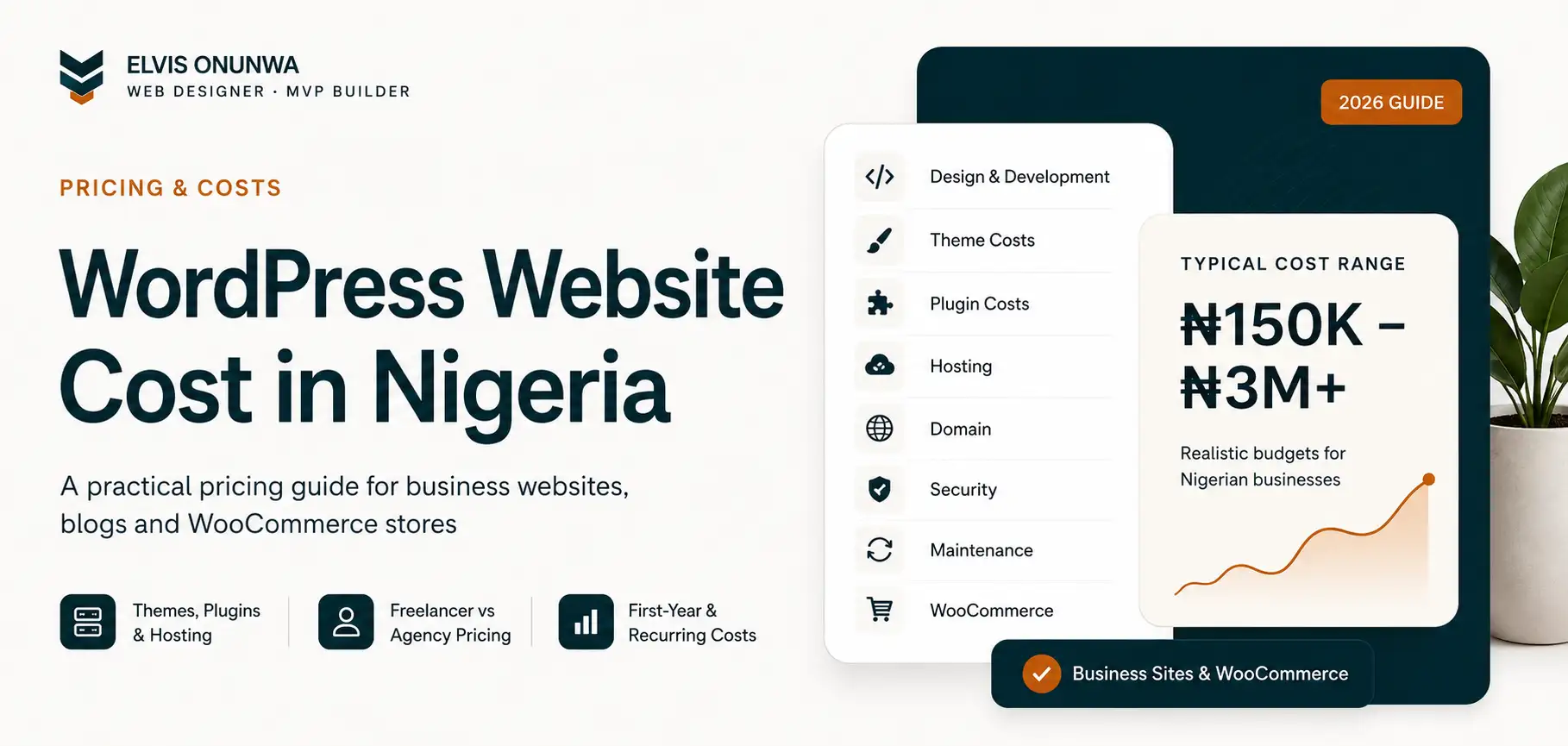
A professionally built WordPress website in Nigeria can cost anywhere from ₦150,000 to more than ₦3 million, depending on the number of pages, design quality, required features, ecommerce functionality and the person or company building it.
A simple one-page WordPress website may cost between ₦95,000 and ₦250,000. A professional small-business website usually falls between ₦200,000 and ₦700,000, while a customised corporate or WooCommerce website can cost ₦700,000 to ₦3 million or more.
Those figures cover more than installing WordPress and choosing a template. A complete budget may include:
Website strategy and design
WordPress development
Domain registration
Hosting
Themes
Plugins
Security and backups
Content upload
Ecommerce configuration
Maintenance and technical support
WordPress itself is open-source software released under the GPL, so you do not pay a licence fee to install it. The real cost comes from designing, building, hosting, securing and maintaining the website.
WordPress website cost in Nigeria at a glance
The following are practical planning ranges for 2026. They are not fixed industry prices. Different developers may charge more or less depending on their experience, processes and the quality of the final work.
WordPress website type | Typical development cost | Best suited to |
|---|---|---|
Personal blog or portfolio | ₦150,000–₦350,000 | Writers, job seekers and independent professionals |
₦95,000–₦250,000 | New businesses with a focused offer | |
Small-business website | ₦200,000–₦700,000 | Consultants, clinics, firms and service businesses |
Professional corporate website | ₦600,000–₦1,800,000 | Established companies and larger organisations |
Basic WooCommerce store | ₦500,000–₦1,500,000 | Small retailers and product businesses |
Advanced WooCommerce store | ₦1,500,000–₦3,500,000+ | Stores requiring custom checkout, automation or integrations |
Membership, directory or booking website | ₦800,000–₦4,000,000+ | Associations, platforms and specialised service businesses |
These ranges are consistent with the wide variation visible across Nigerian web-development pricing. Current Nigerian guides place basic WordPress business websites in the low hundreds of thousands of naira, while corporate and ecommerce projects can run into several million naira.
The important question is therefore not only, “How much does a WordPress website cost?” It is also:
What exactly will the website include, who will own it, and what will it cost to keep it working after launch?
What determines the cost of a WordPress website?
Two WordPress websites can look similar on the surface and have completely different prices.
One may be a lightly edited theme with five pages. The other may include original design, conversion-focused copy, custom forms, analytics, search optimisation, payment integration, automated backups and several weeks of testing.
The main factors affecting the final price are:
The number and complexity of pages
Template-based versus original design
Required plugins and integrations
Ecommerce or payment functionality
Copywriting and content preparation
Product or blog-post uploads
Mobile and performance optimisation
Security requirements
Developer or agency experience
Post-launch maintenance and support
A cheaper quote is not automatically a better deal. Compare what is included, what is excluded and what you will need to pay for again after the first year.
WordPress design and development costs
Website design and website development are related, but they are not the same service.
WordPress design
Design covers how the website communicates and feels to visitors. It includes:
Page structure
Navigation
Typography
Colours
Spacing
Mobile layouts
Calls to action
Content hierarchy
User experience
Brand presentation
A template-based project starts with an existing theme or page design. The developer changes the colours, images, text and sections to fit the business.
A custom-designed WordPress website begins with the business, audience and desired user journey. The layouts may be planned in a design tool before they are developed in WordPress.
WordPress development
Development covers the technical implementation, including:
Installing and configuring WordPress
Setting up the theme
Building page templates
Configuring forms
Creating reusable content sections
Adding plugins
Connecting analytics
Improving loading performance
Setting up redirects
Configuring payment gateways
Testing mobile layouts
Protecting forms from spam
Preparing backups and updates
Typical design and development fees
Build approach | Typical Nigerian price |
Existing theme with minor edits | ₦100,000–₦300,000 |
Theme customised for a real business | ₦200,000–₦700,000 |
Original WordPress business website | ₦500,000–₦1,500,000 |
Custom corporate WordPress system | ₦1,000,000–₦3,000,000+ |
Advanced functionality or integrations | Priced according to scope |
A low-cost template can be appropriate for a new business with simple requirements. It becomes a problem when the template determines the business message instead of supporting it.
WordPress theme costs
A WordPress theme controls much of the website’s visual foundation and page structure.
The official WordPress theme directory contains thousands of free themes, so it is possible to launch without purchasing a premium theme.
Free WordPress themes
A free theme may be suitable for:
A simple blog
A personal portfolio
A basic information website
A small site with no unusual layout requirements
The theme may cost nothing, but a developer will still charge for configuring, styling and adapting it.
Premium WordPress themes
Premium themes generally provide more templates, layout controls, support and advanced design options.
Budget approximately:
Theme option | Typical cost |
Free theme | ₦0 |
Premium theme licence | ₦50,000–₦180,000 |
Theme and template bundle | ₦80,000–₦300,000 |
Custom WordPress theme | ₦300,000–₦1,500,000+ |
Some theme licences require annual renewal. Others provide lifetime access but may charge separately for extended support.
Do not buy a theme simply because its demonstration website looks attractive. Confirm that it is actively maintained, mobile-friendly, compatible with current WordPress versions and not overloaded with features you will never use.
WordPress plugin costs
Plugins add functionality to a WordPress website.
They can provide:
Contact forms
SEO controls
Backups
Security
Ecommerce
Appointment booking
Membership access
Online courses
Email marketing
Analytics
Image optimisation
Multilingual content
Customer portals
The official WordPress plugin directory offers a large collection of free and open-source plugins.
However, many plugins use a freemium model. The basic version is free, while advanced features require an annual subscription.
Typical plugin budget
Website type | Estimated annual plugin cost |
Simple blog or portfolio | ₦0–₦50,000 |
Small-business website | ₦0–₦150,000 |
Professional business website | ₦100,000–₦400,000 |
WooCommerce store | ₦150,000–₦800,000+ |
Booking, membership or learning site | ₦250,000–₦1,000,000+ |
A website does not become better simply because it has more plugins. Every plugin adds another component that must be tested, updated and kept compatible with the rest of the site.
The better approach is to use the smallest reliable set of plugins required to achieve the business goal.
Domain-name cost in Nigeria
Your domain is the address people type to visit your website.
Examples include:
yourbusiness.comyourbusiness.com.ngyourbusiness.ng
As of July 2026, publicly listed Nigerian registrar prices vary significantly.
Current examples include:
.com.ngregistration from approximately ₦5,500 to ₦6,999.ngregistration from approximately ₦13,500 to ₦17,500.comregistration from approximately ₦10,000 to ₦28,300
Renewal prices can be higher than promotional registration prices, so the renewal amount matters more than the first-year discount.
A safe annual planning budget is:
Domain type | Planning budget |
| ₦5,500–₦12,000 yearly |
| ₦13,500–₦25,000 yearly |
| ₦10,000–₦30,000 yearly |
Special or premium domain | Variable |
The business owner should control the registrar account. Your developer may help you purchase and configure the domain, but it should be registered using an account and email address you can access.
WordPress hosting costs in Nigeria
Hosting is the server space where the website’s files and database are stored.
Cheap hosting may be adequate for a small website with limited traffic. A busy WooCommerce store or membership platform needs more processing power, memory, backups and technical support.
Current Nigerian hosting offers show entry-level shared plans starting from roughly ₦1,150 per month, while dedicated WordPress plans commonly start around ₦4,500 per month. Some providers advertise lower prices only when customers pay for several years in advance, and renewal prices may be much higher.
Typical WordPress hosting budget
Hosting type | Estimated annual cost | Suitable for |
Entry-level shared hosting | ₦15,000–₦50,000 | Small blogs and low-traffic sites |
Quality shared WordPress hosting | ₦45,000–₦120,000 | Small-business websites |
Managed WordPress hosting | ₦100,000–₦350,000 | Important business and content websites |
VPS or cloud hosting | ₦250,000–₦1,200,000+ | High-traffic or advanced websites |
Ecommerce-focused hosting | ₦100,000–₦600,000+ | WooCommerce stores |
Do not choose a host based only on storage space. Also consider:
Renewal price
Server performance
Daily backups
Malware scanning
SSL certificates
Customer support
Uptime
Email limits
Staging environments
Traffic and processing limits
A WordPress website with poor hosting can remain slow even after the developer optimises its images and code.
WordPress security costs
An SSL certificate enables HTTPS and encrypts information exchanged between the visitor and the website.
You may not need to pay separately for a basic SSL certificate. Let’s Encrypt provides free TLS certificates, and many Nigerian hosting plans include automated SSL.
However, SSL alone does not make a WordPress website secure.
A complete security plan may include:
Strong administrator access controls
Regular WordPress updates
Theme and plugin updates
Login protection
Automated backups
Malware monitoring
Firewall configuration
Spam protection
Recovery procedures
Restricted administrator accounts
Typical security budget
Security requirement | Estimated cost |
Free SSL certificate | ₦0 |
Basic one-time security configuration | ₦30,000–₦100,000 |
Advanced security setup | ₦100,000–₦300,000 |
Ongoing monitoring and backups | Often included in maintenance |
Emergency malware removal | ₦75,000–₦500,000+ |
Security should be included in the project plan before launch, not purchased only after the website has been compromised.
WordPress maintenance cost in Nigeria
A WordPress website is not a one-time poster that remains unchanged forever.
WordPress, themes and plugins receive updates. Forms must be tested. Backups need to complete successfully. Broken pages, expired licences and compatibility problems must be addressed.
Maintenance may include:
Software updates
Scheduled backups
Security scans
Uptime monitoring
Form testing
Broken-link checks
Performance checks
Small content updates
Plugin licence management
Technical support
Recovery assistance
Typical maintenance pricing
Website type | Monthly maintenance estimate |
Personal or brochure website | ₦10,000–₦30,000 |
Small-business website | ₦20,000–₦60,000 |
Corporate website | ₦40,000–₦120,000 |
WooCommerce store | ₦50,000–₦200,000+ |
High-traffic or business-critical website | Custom pricing |
Some businesses pay only when something goes wrong. That may appear cheaper initially, but emergency work is less predictable and can cost more than preventive maintenance.
Before accepting a maintenance package, ask what it actually covers. “Website maintenance” can mean automated updates only, or it can include hands-on testing, backups, content changes, security monitoring and developer support.
How much does a WooCommerce website cost in Nigeria?
WooCommerce is the open-source ecommerce platform built for WordPress. Its core plugin is free, and WooCommerce does not charge a mandatory platform fee or revenue share simply for using the software.
That does not mean a WooCommerce store is free to build.
An ecommerce project may require:
Product catalogue setup
Product variations
Inventory management
Cart and checkout configuration
Payment-gateway integration
Shipping rules
Transactional emails
Coupon management
Customer accounts
Order-management training
Security hardening
Performance optimisation
Product uploads
Analytics and conversion tracking
Typical WooCommerce development cost
Store type | Estimated development cost |
Very small catalogue store | ₦500,000–₦900,000 |
Standard Nigerian ecommerce store | ₦800,000–₦1,800,000 |
Custom WooCommerce store | ₦1,500,000–₦3,500,000 |
Marketplace or advanced commerce system | ₦3,000,000–₦8,000,000+ |
Paystack and Nigerian payment gateways
Paystack provides an official WooCommerce plugin that allows Nigerian stores to accept payments through supported local and international payment channels. The plugin itself is available through the WordPress plugin directory.
A developer may still charge for:
Installing and configuring the plugin
Connecting live and test credentials
Configuring webhook behaviour
Testing successful and failed transactions
Customising the checkout
Troubleshooting payment conflicts
Setting up order emails
Training the store owner
Payment-gateway transaction charges are separate from the developer’s integration fee.
Paid WooCommerce extensions
Basic product sales may work with free plugins. More advanced requirements can introduce annual licence costs.
For example, subscriptions, bookings, complex pricing, memberships, product add-ons and advanced shipping can require paid extensions. WooCommerce’s official marketplace currently includes extensions costing hundreds of dollars per year, including its subscription product.
For a serious WooCommerce project, budget for both the initial development and recurring extension renewals.
Freelancer versus agency WordPress pricing
Who you hire can affect the cost, process and level of support.
Beginner or low-cost freelancer
Typical price:
₦100,000–₦350,000
May be suitable for:
Personal websites
Simple portfolios
Very small businesses
Projects with a clear template and limited functionality
Possible limitations:
Limited strategy
Heavy dependence on templates
Little documentation
Short post-launch support
Inconsistent testing
No backup developer
Experienced independent WordPress developer
Typical price:
₦250,000–₦1,500,000+
May provide:
Direct communication
Better business understanding
Customised design
Technical integrations
Stronger ownership of the project
More flexible collaboration
This can be a good option for founders and businesses that want experienced attention without paying for a large agency structure.
Small or specialist agency
Typical price:
₦600,000–₦3,000,000+
An agency may provide:
Project management
UI and UX design
Development
Copywriting
SEO
Quality assurance
Multiple specialists
Formal support agreements
Large or established agency
Typical price:
₦1,500,000–₦10,000,000+
This may be appropriate where the project involves:
Many stakeholders
Formal procurement
Extensive documentation
Custom integrations
Security reviews
Large content migrations
Ongoing service agreements
The best option depends on the risk and complexity of the project. A small five-page website does not necessarily need a large agency. A business-critical ecommerce platform should not be handed to someone who only knows how to import a template.
First-year WordPress website costs
The development quote is only one part of the first-year budget.
Example 1: Small-business WordPress website
Item | Estimated cost |
Design and development | ₦200,000–₦600,000 |
Domain | ₦5,500–₦30,000 |
Hosting | ₦30,000–₦120,000 |
Theme and plugins | ₦0–₦200,000 |
Security and backups | ₦0–₦100,000 |
Maintenance | ₦120,000–₦480,000 |
Estimated first-year total | ₦355,500–₦1,530,000 |
Example 2: Professional corporate WordPress website
Item | Estimated cost |
Design and development | ₦600,000–₦1,800,000 |
Domain | ₦5,500–₦30,000 |
Hosting | ₦80,000–₦300,000 |
Themes and plugins | ₦100,000–₦500,000 |
Security and backups | ₦50,000–₦250,000 |
Maintenance | ₦360,000–₦1,200,000 |
Estimated first-year total | ₦1,195,500–₦4,080,000 |
Example 3: WooCommerce store
Item | Estimated cost |
Design and development | ₦700,000–₦3,000,000 |
Domain | ₦5,500–₦30,000 |
Ecommerce hosting | ₦100,000–₦600,000 |
Theme and extensions | ₦150,000–₦1,000,000 |
Security and backups | ₦100,000–₦400,000 |
Maintenance | ₦600,000–₦2,400,000 |
Estimated first-year total | ₦1,655,500–₦7,430,000 |
A small store will not always require the upper end of this budget. The cost rises when there are many products, unusual shipping rules, subscriptions, vendor accounts, bookings, external software integrations or custom checkout requirements.
Recurring WordPress costs after the first year
Once the website has launched, recurring costs may include:
Expense | Typical annual range |
Domain renewal | ₦5,500–₦30,000 |
Hosting | ₦15,000–₦600,000+ |
Theme renewal | ₦0–₦180,000 |
Plugin renewals | ₦0–₦1,000,000+ |
Maintenance | ₦120,000–₦2,400,000+ |
Security and backups | ₦0–₦400,000 |
Content and SEO work | Separate budget |
For a normal small-business WordPress website, a reasonable recurring budget may be ₦150,000 to ₦700,000 per year.
A WooCommerce store or business-critical site may require ₦600,000 to several million naira per year, especially when active development, technical support and premium extensions are involved.
Can you build a WordPress website for ₦100,000?
It is possible, but the scope must be limited.
At that price, you should generally expect:
One page or a very small number of pages
An existing theme
Limited custom design
Content supplied by the client
Basic contact or WhatsApp functionality
Few or no paid plugins
Limited revisions
Short post-launch support
You should not expect a fully customised corporate website, advanced SEO, professional copywriting, complex integrations and long-term maintenance within the same ₦100,000 budget.
A focused one-page website can still be valuable when it clearly explains the business, presents the offer professionally and makes it easy for visitors to enquire.
Hidden WordPress costs to ask about
Before accepting a quote, confirm whether the following are included:
Domain registration and renewal
Hosting and renewal
Premium theme licence
Plugin licences
Copywriting
Stock photographs
Product uploads
Business email
Payment-gateway setup
SEO setup
Analytics
Maintenance
Technical support
Future edits
Website migration
Backup restoration
Training
VAT or transaction charges
Also ask who owns the domain, hosting account, WordPress administrator account, theme licences and plugin licences.
You should be able to access and control the important accounts connected to your website.
How to reduce your WordPress website cost without damaging the project
You can control the budget by reducing unnecessary scope rather than reducing quality everywhere.
Start with these decisions:
Launch with fewer pages
A focused five-page website is better than 20 unfinished pages.
Use free plugins where they meet the requirement
Do not purchase a premium licence merely because it appears on a developer’s standard checklist.
Prepare your content early
Late content changes often create redesign and development work.
Prioritise one clear conversion goal
Decide whether visitors should call, send a WhatsApp message, complete a form, book an appointment or buy a product.
Avoid unnecessary animations
Complex effects increase development time and may reduce performance without improving results.
Build advanced features in phases
Launch the essential website first. Add memberships, dashboards, automation or complex ecommerce functionality after the basic customer journey has been proven.
Questions to ask a WordPress developer
Before making payment, ask:
What pages and features are included?
Will the design be custom or template-based?
Are theme and plugin licences included?
Who owns the domain and hosting?
What happens when licences expire?
Is mobile optimisation included?
Is basic search setup included?
Will you configure backups and security?
Is content upload included?
How many revisions are included?
What support is available after launch?
How much will yearly maintenance cost?
Can I edit the website myself?
Will I receive administrator access?
Are there additional fees not shown in the quote?
A professional developer should be able to explain the scope in plain language.
Is WordPress the right choice for your business?
WordPress is usually a strong option for:
Business websites
Blogs and content websites
Professional-service firms
News and publishing platforms
Portfolios
Corporate websites
Membership websites
Course platforms
Directories
WooCommerce stores
It may not be the best option when the project requires a highly specialised application, complicated real-time workflows or extensive custom product logic. In those cases, a custom web application or different platform may be more appropriate.
Final answer: how much should you budget?
For most Nigerian businesses, a sensible 2026 WordPress budget is:
₦95,000–₦250,000 for a focused one-page starter website
₦200,000–₦700,000 for a professional small-business website
₦600,000–₦1,800,000 for a more customised corporate website
₦500,000–₦1,500,000 for a basic WooCommerce store
₦1,500,000–₦3,500,000+ for an advanced ecommerce project
You should also plan for recurring domain, hosting, plugin and maintenance costs after launch.
The cheapest WordPress quote is not necessarily the lowest-cost option over time. A useful website must be clear, fast, secure, maintainable and connected to a real business goal.
Need a WordPress website for your business?
I help Nigerian businesses plan and build professional WordPress websites that clearly explain what they offer and make it easier for potential customers to take action.
Instead of starting with a random theme, I begin with your business, audience, content and conversion goal. The final scope can cover design, WordPress development, mobile optimisation, forms, WhatsApp enquiries, search setup, security and launch support.
Tell me about your project to receive a practical scope and cost estimate.
Frequently asked questions
How much does a WordPress website cost in Nigeria?
A WordPress website in Nigeria generally costs between ₦150,000 and ₦3 million or more. A small-business site may cost ₦200,000 to ₦700,000, while an advanced WooCommerce or custom website may exceed ₦1.5 million.
Is WordPress free?
The WordPress software is free and open source. You still need to pay for a domain, hosting, design, development and any premium themes or plugins required by the website.
How much is WordPress hosting in Nigeria?
Entry-level hosting may cost approximately ₦15,000 to ₦50,000 per year. Better WordPress hosting can cost ₦45,000 to ₦350,000 per year, while cloud, VPS and ecommerce hosting may cost substantially more. Current Nigerian provider prices vary according to term length and renewal conditions.
How much does a WooCommerce website cost in Nigeria?
A basic WooCommerce store may cost ₦500,000 to ₦1.5 million. A store requiring custom checkout, subscriptions, complex shipping, marketplaces or external integrations may cost ₦1.5 million to ₦3.5 million or more.
Does WooCommerce charge a monthly subscription?
The core WooCommerce plugin is free and does not impose a mandatory platform subscription. You will still pay for hosting, development, payment processing and any premium extensions required by the store.
Is Paystack available for WooCommerce?
Yes. Paystack provides a WooCommerce payment-gateway plugin that supports payments through its available local and international channels.
Should I hire a freelancer or a WordPress agency?
Hire based on the project’s risk and complexity. An experienced freelancer may be ideal for a focused business website. An agency may be more suitable where the project requires several specialists, extensive documentation, formal project management or continuous support.
How long does it take to build a WordPress website?
A small WordPress website may take one to three weeks. A customised business website may take three to eight weeks, while a large WooCommerce or corporate project can take several months. Content delays and late scope changes can extend the timeline.
Do I have to pay for WordPress maintenance?
You can maintain the website yourself, but someone must still perform updates, backups, security checks and compatibility testing. Businesses that do not have internal technical support should budget for professional maintenance.
Who should own my domain and hosting?
The business owner should have direct access to the domain registrar, hosting account and WordPress administrator account. A developer can manage them on your behalf without becoming the only person who controls them.
Publishing note
Prices were researched and updated on 20 July 2026. Domain, hosting, theme and plugin prices can change, especially where providers use promotional first-year pricing or bill in foreign currency.