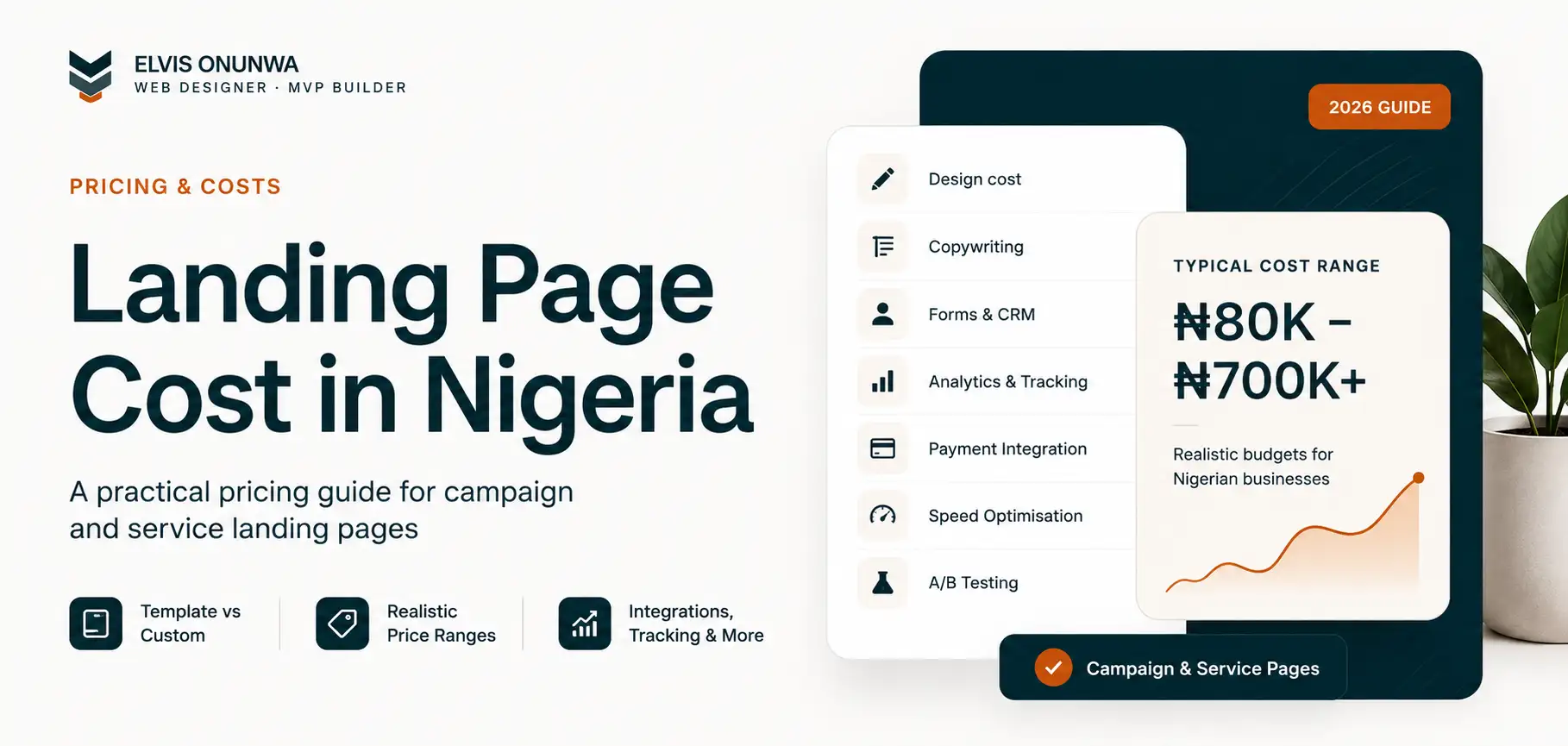
A professionally designed landing page in Nigeria typically costs ₦80,000 to ₦450,000 in 2026.
A simple template-based page may stay near the lower end of that range. A custom conversion-focused landing page with professional copywriting, lead management, payment integration and campaign tracking can cost ₦300,000 to ₦700,000. More advanced projects involving multiple page variations, automation and ongoing A/B testing may exceed ₦1 million.
These are not official industry prices. They are practical budgeting ranges based on published Nigerian web-design rates, current landing-page packages and the additional work required for conversion strategy, integrations and optimisation.
Current Nigerian providers publicly quote approximately ₦80,000–₦300,000 for basic or standard landing-page projects. One provider gives a real project example of ₦180,000 for a responsive startup landing page with email capture, Mailchimp integration and analytics. Other published ranges extend considerably higher for custom campaign work.
Landing page cost in Nigeria at a glance
Type of landing page | Typical Nigerian price |
|---|---|
DIY page using a template | ₦20,000–₦80,000 in direct costs |
Professionally customised template | ₦80,000–₦180,000 |
Custom service landing page | ₦180,000–₦450,000 |
Campaign page with CRM and tracking | ₦300,000–₦700,000 |
Sales page with payment and automation | ₦350,000–₦850,000 |
Campaign system with A/B testing | ₦600,000–₦1,500,000+ |
The final cost depends less on the number of sections and more on what the page must accomplish.
A page that only displays a service and WhatsApp button is relatively straightforward. A page that must qualify leads, send them into a CRM, record advertising conversions, collect payments and test multiple messages requires more planning and technical work.
What is a landing page?
A landing page is a focused web page built around one primary action.
That action might be:
Requesting a quotation
Booking a consultation
Joining a waiting list
Registering for an event
Downloading a resource
Purchasing a product
Applying for a programme
Starting a WhatsApp conversation
Unlike a regular homepage, a campaign landing page usually removes unnecessary choices. The headline, supporting information, proof, form and call to action all support the same offer.
However, not every one-page website is a landing page.
A one-page business website may introduce the company, list several services, show projects and provide multiple contact options. A true landing page normally focuses on a particular audience, problem, offer and conversion action.
What determines the cost of a landing page in Nigeria?
The biggest cost factors are:
Whether the page uses a template or a custom design
Whether the client supplies finished copy
The complexity of the form or lead-capture process
CRM and email-marketing integrations
Analytics and advertising tracking
Payment-gateway requirements
Mobile and speed optimisation
The number of campaign variations
The amount of research and conversion strategy required
Whether the page is temporary or intended to rank permanently
Two pages can contain the same number of sections but require very different levels of work.
For example, a page promoting a ₦20,000 training class may need a headline, programme outline, tutor profile and Paystack button. A landing page for a high-value consulting service may require audience interviews, competitive research, case studies, lead qualification, calendar scheduling and CRM automation.
The second page is more expensive because the business decision behind every section is more demanding.
Template versus custom landing pages
Template-based landing pages
A template-based landing page starts from an existing layout. The designer changes the colours, fonts, images, content and sections to match the business.
Templates can be built with:
WordPress
Webflow
Framer
Wix
Carrd
Shopify
Unbounce
Leadpages
An existing website component library
Typical cost in Nigeria
A professionally customised template generally costs ₦80,000 to ₦180,000.
Very basic work may cost less, especially when the client already has the copy, brand assets and hosting. The cost can increase when the template requires substantial restructuring or custom code.
When a template is a sensible choice
A template may be sufficient when:
You are validating a new offer
You need to launch quickly
Your advertising budget is still small
You have a straightforward lead form
You already have strong copy
The page does not need unusual interactions
You are running a short event or registration campaign
Template limitations
The main problem is not that templates are automatically bad. The problem is forcing an offer into a layout that was designed for someone else.
This can lead to:
Sections that do not support the buying decision
Generic headlines
Unnecessary animations
Weak mobile layouts
Too many calls to action
Limited tracking flexibility
A page that looks similar to competing businesses
A well-chosen and carefully customised template can perform well. A poorly chosen template can make a serious business appear generic.
Custom landing pages
A custom landing page is planned and designed around the business’s offer, target audience and conversion journey.
The designer does not simply replace the text and images in an existing layout. The content hierarchy, visual structure and interactions are created for the campaign.
Typical cost in Nigeria
A custom landing page generally costs ₦180,000 to ₦450,000.
A more advanced campaign page with custom copywriting, CRM integration, payment processing and detailed conversion tracking may cost ₦300,000 to ₦700,000.
When custom design is worth paying for
Custom design is usually more suitable when:
You are spending significantly on advertising
The service has a high customer value
The offer requires detailed explanation
Your brand must look distinct
You need custom forms or qualification steps
You want multiple campaign variations
The page will remain in use for a long time
A poor conversion rate would waste a substantial advertising budget
Custom does not have to mean visually complicated. Some of the strongest landing pages are visually simple because the design keeps attention on the message and action.
Landing-page design costs
Design covers the page’s visual presentation and user experience. It may include:
Content hierarchy
Wireframes
Desktop design
Mobile design
Typography
Colour application
Call-to-action placement
Form design
Trust and proof sections
Responsive behaviour
Component states
Developer handoff
Typical design-only costs
Design scope | Estimated cost |
Template colour and content changes | ₦30,000–₦80,000 |
Significant template restructuring | ₦70,000–₦150,000 |
Custom desktop and mobile design | ₦120,000–₦300,000 |
Research-led campaign UX design | ₦200,000–₦500,000+ |
Design and development are often bundled into one quotation. Ask whether the price covers only a Figma design or includes the working page.
A beautiful design file that has not been developed, connected to forms or tested on real devices is not a completed landing page.
Landing-page copywriting costs
Copywriting is one of the most underestimated parts of a landing-page project.
The copy must answer questions such as:
Who is this offer for?
What problem does it solve?
Why should the visitor care now?
What exactly is included?
Why should the visitor trust the business?
What happens after the visitor submits the form?
What objection could prevent the visitor from acting?
The designer may arrange existing content, but that is different from researching and writing conversion copy.
Typical copywriting costs in Nigeria
Copywriting service | Estimated cost |
Formatting client-supplied copy | Included or ₦10,000–₦30,000 |
Editing and improving existing copy | ₦30,000–₦80,000 |
Original conversion copy | ₦80,000–₦250,000 |
Research-heavy sales-page copy | ₦200,000–₦600,000+ |
Specialist direct-response copywriters may charge considerably more, especially when the project includes customer research, interviews, offer positioning, competitor analysis or multiple campaign versions. International pricing surveys also show that sales and landing-page copy is generally priced higher than ordinary informational website content.
When you may not need a separate copywriter
You may not need a full copywriting service when:
The offer is extremely straightforward
You already have tested campaign copy
Your internal team understands the audience
The page is only a temporary registration page
The designer is competent in content strategy
However, “we will send the content later” is one of the easiest ways to delay a landing-page project.
The structure should be planned around real copy, not placeholder text.
Form and CRM integration costs
A basic form may collect:
Name
Email address
Phone number
Message
It can send the submission to an email address or store it in the website database.
That is different from a lead-management system that:
Adds the lead to a CRM
Records the traffic source
Applies a campaign tag
Assigns the lead to a salesperson
Sends an automatic email
Starts a WhatsApp conversation
Creates a follow-up task
Prevents duplicate submissions
Sends conversion data back to an advertising platform
Typical form and CRM integration costs
Integration | Estimated cost |
Basic contact form | ₦10,000–₦40,000 |
Form with validation and autoresponse | ₦25,000–₦70,000 |
Mailchimp or email-list connection | ₦30,000–₦100,000 |
HubSpot or similar CRM integration | ₦50,000–₦200,000 |
Custom API, webhook or lead-routing workflow | ₦120,000–₦400,000+ |
The software subscription is normally separate from the setup cost.
For example, a developer may charge once to connect your form to a CRM, while the CRM provider charges your business monthly according to its own plan and contact limits.
Questions to answer before requesting a quotation
Decide:
What information should the form collect?
Which fields are compulsory?
Where should submissions be stored?
Who should receive the notification?
Should the visitor receive an automatic response?
Should leads be tagged by campaign?
What should happen when the integration fails?
Who owns the CRM account?
Clear answers reduce both cost and implementation delays.
Analytics and tracking costs
A landing page should not merely exist. You should be able to tell whether it is working.
At minimum, tracking should answer:
How many people visited?
Where did they come from?
How many submitted the form?
How many clicked WhatsApp?
How many started checkout?
How many completed payment?
Which campaign produced the conversion?
Google Analytics provides a free standard analytics product, but a professional may still charge for account configuration, event setup, testing and reporting.
Typical analytics setup costs
Tracking requirement | Estimated cost |
Basic Google Analytics installation | ₦15,000–₦40,000 |
GA4 events and conversion setup | ₦30,000–₦100,000 |
Meta Pixel or Google Ads conversion tracking | ₦25,000–₦80,000 per platform |
Google Tag Manager configuration | ₦40,000–₦150,000 |
Advanced cross-platform tracking | ₦100,000–₦300,000+ |
Basic installation means adding the tracking code.
A proper conversion setup means defining events, testing whether they fire correctly and ensuring the events represent meaningful business actions.
For example, recording every click on a page as a conversion will make campaign reports appear successful even when the clicks do not produce real enquiries or sales.
Tracking should be tested before launch
Ask the provider to test:
Form submissions
Thank-you page visits
Phone-number clicks
WhatsApp clicks
Calendar bookings
Checkout starts
Successful payments
Failed payments
A landing page should not begin receiving paid traffic before its critical conversion events have been verified.
Payment-integration costs
A Nigerian landing page can accept payments through providers such as Paystack or Flutterwave.
There are several levels of payment integration.
1. Payment-link button
The simplest method is a button that opens a payment page hosted by the provider.
This is suitable for:
Event registrations
Course sales
Deposits
Simple products
Consultation payments
Typical setup cost: ₦20,000–₦60,000.
2. Embedded or inline checkout
The payment window opens from the landing page without sending the customer through a completely separate purchasing flow.
Typical setup cost: ₦50,000–₦150,000.
3. Custom payment workflow
The landing page creates an order, starts payment, verifies the transaction, records the result, sends confirmation and triggers fulfilment.
This may require:
Backend development
Payment verification
Webhooks
Order records
Email notifications
Receipt generation
Failed-payment handling
Duplicate-payment protection
Typical setup cost: ₦120,000–₦400,000+.
Payment transaction fees are separate
The development fee pays for setting up the payment experience. It does not replace the gateway’s transaction charges.
Paystack currently lists its Nigerian local transaction fee as 1.5% plus ₦100, with the ₦100 waived for transactions below ₦2,500 and local fees capped at ₦2,000.
Flutterwave currently lists a 2% fee for Nigerian local payments, comprising a 1.4% transaction fee and 0.6% platform fee. Flutterwave also explains that VAT applies to its fees.
These charges can change, so confirm the provider’s current pricing before publishing a campaign budget.
Speed-optimisation costs
Speed optimisation should not be treated as an optional cosmetic extra.
A slow page can create problems before the visitor has a chance to read the offer or complete the form.
Landing-page speed work may include:
Compressing images
Serving modern image formats
Removing unused scripts
Reducing font files
Loading non-essential resources later
Preventing layout shifts
Improving server response
Reducing third-party tracking overhead
Testing on slower mobile connections
Configuring caching and content delivery
Typical speed-optimisation costs
Speed work | Estimated cost |
Basic optimisation during a new build | Usually included |
Existing-page speed audit and fixes | ₦30,000–₦120,000 |
Advanced performance remediation | ₦120,000–₦300,000+ |
Google’s current Core Web Vitals guidance recommends an LCP of no more than 2.5 seconds, an INP of no more than 200 milliseconds and a CLS of no more than 0.1 for a good user experience.
These metrics should be treated as diagnostic targets rather than a guarantee of rankings or sales. Google also states that page experience involves several signals and that perfect performance scores alone do not guarantee a top search position.
A/B testing costs
A/B testing compares two versions of a page or page element.
For example:
Headline A versus headline B
Short form versus long form
“Book a consultation” versus “Request a quotation”
Price shown versus price hidden
Testimonial section near the top versus near the bottom
Video explanation versus text explanation
Visitors are divided between the versions, and the business measures which version produces better results.
Typical A/B testing costs
A/B testing work | Estimated cost |
Planning and setting up one test | ₦60,000–₦250,000 |
Designing and developing a major page variation | ₦100,000–₦350,000 |
Monthly conversion-optimisation support | ₦150,000–₦600,000+ |
Testing software | Separate monthly subscription |
Google Optimize is no longer available; Google ended the product on September 30, 2023. Businesses now need another testing platform or a custom split-testing implementation.
Specialised landing-page platforms can add recurring dollar-denominated costs. Unbounce, for example, currently advertises entry plans beginning at $22 per month, while plans with broader building and experimentation capabilities cost more.
Do not pay for A/B testing too early
A/B testing is not automatically the best next step for every business.
When a campaign has very little traffic, it may take too long to collect useful evidence. In that situation, the business may benefit more from:
Clarifying the offer
Improving the copy
Interviewing leads
Fixing tracking
Reviewing sales calls
Improving page speed
Removing obvious usability problems
Testing software cannot compensate for an unclear offer or the wrong audience.
Campaign landing pages versus permanent service pages
A campaign landing page and a permanent service page can look similar, but they serve different purposes.
Factor | Campaign landing page | Permanent service page |
Main traffic source | Paid ads, email or social campaigns | Google Search, referrals and website navigation |
Primary goal | One immediate conversion | Explain a service and generate long-term enquiries |
Navigation | Often limited | Usually connected to the main website |
Lifespan | Temporary or campaign-specific | Intended to remain useful for years |
Content | Focused on one campaign promise | Broader, more comprehensive service information |
SEO priority | Optional or secondary | Usually important |
Testing | Frequently tested | Updated more carefully |
Typical cost | ₦200,000–₦700,000 | ₦180,000–₦450,000 |
Campaign landing pages
A campaign page is normally created for a specific traffic source or promotion.
Examples include:
A Facebook advertisement for a masterclass
A Google Ads campaign for an immigration lawyer
A property inspection promotion
A product pre-order
A webinar registration campaign
A limited-time consultation offer
The page can use the exact language of the advertisement and remove links that distract from the conversion.
Some temporary or duplicate campaign pages may be intentionally excluded from search results. Google documents the noindex directive as the proper method for preventing a page from appearing in Google Search.
Permanent service pages
A permanent service page should be designed to remain useful after an advertising campaign ends.
It may need:
Detailed service information
Frequently asked questions
Examples or case studies
Pricing guidance
Internal links
Related services
Clear contact options
Search-friendly headings
Original expert information
Google recommends creating reliable, people-first content and placing the words people use to find the content in prominent locations such as the title and main heading. It also recommends crawlable internal links.
A permanent service page should not be reduced to a thin advertisement merely because the business also wants conversions.
Should you build both?
Businesses running paid campaigns and investing in SEO may need both.
The permanent service page can target broader organic searches and support the main website. The campaign landing page can match a particular advertisement, audience or promotion.
When the two pages contain substantially similar content, their search-indexing and canonical setup should be considered carefully. Google recommends specifying a preferred canonical URL for duplicate or very similar pages.
Three sample landing-page budgets
The following examples are budgeting models, not fixed quotations.
Budget 1: Permanent landing page for a service business
Suitable for a consultant, agency, lawyer, contractor or professional service.
Item | Example cost |
Offer and page planning | ₦30,000 |
Copywriting and editing | ₦70,000 |
Custom design and development | ₦150,000 |
Contact form and WhatsApp setup | ₦20,000 |
Basic analytics | ₦25,000 |
Performance testing | ₦25,000 |
Estimated total | ₦320,000 |
This page should be connected to the main website, internally linked and designed to remain useful beyond a single campaign.
Budget 2: Lead-generation campaign page
Suitable for Facebook, Instagram or Google advertising.
Item | Example cost |
Campaign and offer strategy | ₦50,000 |
Conversion copywriting | ₦120,000 |
Custom design and development | ₦220,000 |
CRM and autoresponse integration | ₦80,000 |
Advertising conversion tracking | ₦60,000 |
One additional campaign variation | ₦100,000 |
Estimated total | ₦630,000 |
Advertising spend and CRM subscriptions are not included.
Budget 3: Product or course sales page
Suitable for a digital product, event, cohort or training programme.
Item | Example cost |
Offer planning | ₦60,000 |
Long-form sales copy | ₦150,000 |
Design and development | ₦250,000 |
Payment workflow | ₦100,000 |
Analytics and advertising tracking | ₦70,000 |
Email automation | ₦100,000 |
Speed optimisation | ₦50,000 |
Estimated total | ₦780,000 |
Payment-gateway charges, email-platform subscriptions and advertising costs are separate.
Other costs to include in your budget
Your quotation may not include:
Domain registration
Hosting
Premium templates
Stock photography
Video production
Product photography
CRM subscriptions
Email-marketing subscriptions
Calendar software
A/B testing tools
Transaction fees
Maintenance
Advertising spend
Additional campaign versions
Major revisions after approval
Published Nigerian estimates place domains around ₦5,000–₦15,000 per year and hosting around ₦30,000–₦150,000 per year, although the actual amount depends on the extension, provider, traffic and hosting quality.
Always ask which recurring costs will continue after launch.
How to calculate your landing-page budget
Use this formula:
Total landing-page cost = planning + copywriting + design + development + integrations + tracking + payment setup + optimisation + testing + recurring software
Do not add every possible service automatically. Choose what the project genuinely needs.
For example:
A simple local service may only need copy, design, a form and analytics.
An event page may need payment but no CRM.
A high-value B2B campaign may need lead qualification and CRM routing but no online payment.
A permanent SEO service page may need more detailed content but no A/B testing platform.
How to reduce the cost without damaging the page
1. Promote one clear offer
A page becomes harder to plan when it tries to promote five unrelated services.
Choose one audience, one primary problem and one main conversion action.
2. Prepare your business information
Provide:
Service details
Pricing or pricing logic
Customer objections
Testimonials
Project examples
Brand files
Contact details
Frequently asked questions
Terms that affect the offer
Good inputs reduce research and revision time.
3. Use a template for early validation
A properly customised template may be enough when you are testing a new idea.
Move to custom design when the offer has been validated or the advertising investment justifies a more specialised page.
4. Begin with a payment link
A hosted Paystack or Flutterwave link can be more affordable than developing a full payment system.
A custom workflow becomes more valuable when you need order records, automatic fulfilment, receipts or payment-status management.
5. Avoid unnecessary software
Do not pay monthly for advanced landing-page or A/B testing software when the page receives little traffic and will rarely change.
6. Define the approval process
Agree on:
Who supplies the content
Who approves the design
How many revisions are included
What counts as a new request
Who provides access to external platforms
Uncontrolled revisions can increase both cost and delivery time.
Where you should not cut costs
Saving money becomes expensive when it removes essential work.
Do not remove:
Mobile testing
Form testing
Conversion tracking
Basic speed optimisation
Clear copy
Account ownership
Payment verification
Security updates
Backup or recovery arrangements
A cheap page that cannot record enquiries correctly is not cheaper. It is simply unfinished.
Questions to ask a landing-page designer
Before accepting a quotation, ask:
Is the page based on a template or custom-designed?
Does the price include copywriting?
Are desktop and mobile layouts included?
Who will own the domain, hosting and platform accounts?
What form or CRM integrations are included?
Will analytics and conversion events be configured?
Does payment setup include transaction verification?
How many revisions are included?
Will the page be tested on real mobile devices?
Are recurring software costs separate?
Is post-launch support included?
Can the page be edited or moved later?
The answers matter more than the number of features written in the quotation.
Which landing-page budget is right for you?
Budget below ₦100,000
This may be sufficient for:
A simple temporary page
A lightly customised template
A waitlist
A basic event registration
A page with supplied copy
A single WhatsApp action
Expect limited strategy, original design and automation.
Budget of ₦100,000–₦250,000
This is a realistic range for:
A professionally customised template
A startup validation page
A simple service landing page
A campaign page with a standard form
Basic analytics and mobile optimisation
Budget of ₦250,000–₦500,000
This is more suitable for:
Custom design
Professional conversion copy
Permanent service pages
CRM integration
Payment integration
Advertising tracking
Higher-value services
Budget above ₦500,000
This becomes reasonable when the project includes:
Extensive audience research
Long-form sales copy
Multiple campaign variations
Advanced automation
Custom payment workflows
Several advertising platforms
Ongoing conversion optimisation
High advertising or customer value
The right amount should be compared with the value of the campaign, not merely the physical length of the page.
Is a landing page worth the cost?
A landing page is worth the investment when it gives the business a measurable path from visitor to lead or customer.
It is less likely to be worthwhile when:
The offer is unclear
The business has no plan for attracting visitors
Nobody follows up with leads
The page promotes too many unrelated actions
Tracking is not configured
The business cannot fulfil the promise being advertised
The landing page is one part of the customer-acquisition system. Traffic quality, offer strength, sales follow-up and service delivery still matter.
Working with Me on your landing page
I approache landing pages as focused business systems rather than isolated graphic-design projects.
The work can include offer clarification, conversion-focused copy structure, responsive design, development, forms, WhatsApp actions, analytics, payment setup and launch support.
The recommended scope depends on whether you need a temporary campaign page, a permanent service page or a complete lead-generation workflow. You should not be pushed into advanced integrations or testing tools that your current campaign does not need.
Request a landing-page quotation based on your actual offer, traffic source and conversion goal.
Frequently asked questions
How much does a landing page cost in Nigeria?
A professionally created landing page in Nigeria usually costs between ₦80,000 and ₦450,000. Advanced campaign pages with professional copywriting, CRM integration, payment processing and detailed tracking may cost between ₦300,000 and ₦1 million or more.
Can I get a landing page for ₦50,000?
It is possible, particularly when using a simple template and client-supplied content. However, ₦50,000 may not cover original design, conversion copywriting, CRM integration, payment verification or advanced analytics.
Is copywriting included in landing-page design?
Not always. Some designers only place the content supplied by the client. Ask whether the quotation includes original copywriting, editing or only content formatting.
Does a landing page need hosting and a domain?
Yes, unless it is being published on an existing website or a hosted landing-page platform. A dedicated domain is not always necessary; the page can often use a path or subdomain belonging to the main business website.
How much does Paystack integration cost?
A simple Paystack payment-link button may cost around ₦20,000–₦60,000 to configure. An embedded checkout or custom verified payment workflow may cost ₦50,000–₦400,000 or more, depending on the required records, automation and fulfilment process. Paystack’s transaction fees are separate from the developer’s integration charge.
Do I need A/B testing?
Not necessarily. A/B testing is most useful when the page receives enough relevant traffic and the business can measure a meaningful conversion. Smaller campaigns should first fix obvious problems with the offer, copy, tracking, form and mobile experience.
Is a campaign landing page good for SEO?
It can be indexed, but campaign pages are often too narrow, temporary or similar to existing service pages to become strong organic-search assets. A permanent service page should provide more complete, original and internally linked information for search visitors.
What is the difference between a landing page and a website?
A landing page focuses on one primary offer or action. A website normally contains several pages covering the business, services, projects, contact information and other resources.
Final answer
For most Nigerian businesses, a sensible 2026 landing-page budget is:
₦80,000–₦180,000 for a customised template
₦180,000–₦450,000 for a custom service landing page
₦300,000–₦700,000 for a serious campaign page with integrations
₦600,000–₦1,500,000+ for advanced testing, automation and multiple variants
Do not judge a quotation only by the fact that the project contains one page.
Compare the strategy, copy, design, mobile experience, lead handling, analytics, payment process, speed, ownership and post-launch support included in the price.
The cheapest page is not the page with the lowest quotation. It is the page that achieves the required business result without unnecessary complexity or avoidable recurring costs.
Research note
The estimates in this guide were developed from current publicly available Nigerian landing-page and web-design pricing, feature comparisons and official platform charges. Published provider prices vary because “landing page” can describe anything from a lightly edited template to a complete conversion and payment system. The ranges should therefore be used for initial budgeting rather than treated as mandatory market rates.