On this pageJump to a section
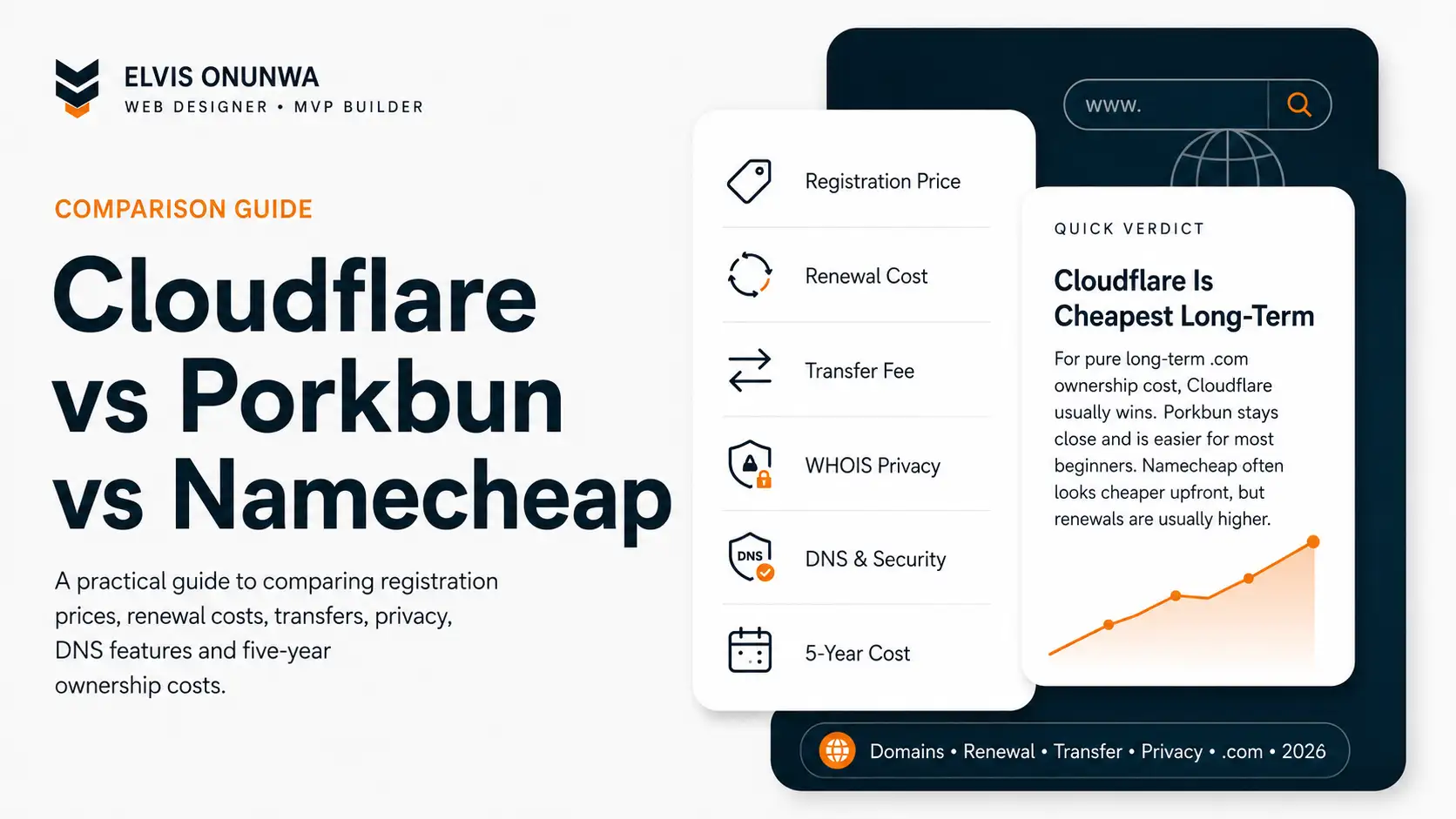
Cloudflare Registrar is currently the cheapest of the three for long-term .com ownership, provided you are comfortable using Cloudflare’s nameservers.
Porkbun costs only slightly more and is the better all-round choice for beginners, small-business owners and people who want the freedom to use another DNS provider. Namecheap can look cheaper during the first year, but its higher renewal price makes it considerably more expensive over five years.
Using publicly listed United States pricing checked on July 24, 2026, one standard .com domain would cost approximately:
Registrar | Estimated first year | Estimated renewal | Five-year cost |
|---|---|---|---|
Cloudflare Registrar | $10.46 | $10.46 | $52.30 |
Porkbun | $11.08 | $11.08 | $55.40 |
Namecheap | $11.18 | $18.68 | $85.90 |
These totals use registration plus four renewals. They exclude sales tax, premium-domain charges, expired-domain restoration, hosting, business email and optional security products.
The difference between Cloudflare and Porkbun is small: approximately $3.10 over five years for one .com domain. The larger difference is between either of them and Namecheap, whose promotional first-year pricing is followed by a much higher standard renewal price.
Prices vary by extension and can change when registries increase their wholesale rates. Always verify the checkout total before buying.
Quick verdict
Here is the practical answer for most buyers.
Need | Best choice | Why |
Lowest long-term domain cost | Cloudflare Registrar | Domains are sold at registry and ICANN cost without a registrar markup |
Best for beginners | Porkbun | Simple interface, transparent renewal pricing and fewer ecosystem restrictions |
Best for developers using Cloudflare | Cloudflare Registrar | Registrar, DNS, DNSSEC, SSL, CDN and security controls stay in one account |
Best 24/7 live support | Namecheap | Round-the-clock live chat and ticket support |
Best phone support | Porkbun | US telephone support during published business hours |
Best for domains plus hosting or email | Namecheap | Broader catalogue of hosting, email, SSL and related services |
Best for one ordinary business domain | Porkbun | Low renewal cost without requiring Cloudflare nameservers |
Best for a large Cloudflare-managed portfolio | Cloudflare Registrar | Lowest carrying cost and API-oriented management |
Best for flexible portfolio management | Porkbun | Low prices while retaining control over nameservers |
Best for chasing first-year promotions | Namecheap | Regular introductory sales, although renewals require closer attention |
My overall recommendation: Choose Cloudflare when you already use or are happy to use Cloudflare DNS. Choose Porkbun when you want nearly the same low price with more flexibility and a friendlier experience. Choose Namecheap when its support and broader product ecosystem matter more than the lowest renewal cost.
Cloudflare vs Porkbun vs Namecheap price comparison
A registrar’s first-year price is only one part of the cost.
For a domain you intend to keep, renewal pricing matters more. A discount of a few dollars during registration can be erased by a renewal price that is $7 or $8 higher every subsequent year.
Current .com pricing
Cost | Cloudflare Registrar | Porkbun | Namecheap |
New registration | About $10.46 | $11.08 | $10.98 advertised sale price |
ICANN fee | Included in estimate | Included | Approximately $0.20 may be added |
Estimated checkout price | About $10.46 | $11.08 | About $11.18 |
Renewal | About $10.46 | $11.08 | $18.48 advertised |
Estimated renewal with ICANN fee | About $10.46 | $11.08 | About $18.68 |
Transfer | At cost | $11.08 | $11.48 advertised, plus applicable ICANN fee |
WHOIS privacy | Free where permitted | Free where permitted | Free where permitted |
Promotional first-year pricing | No traditional discounts | Sometimes | Frequently |
Cloudflare says it charges customers only the registry wholesale price and applicable ICANN fee, without adding a registrar markup. The current Verisign wholesale price for a .com domain is $10.26, and the ICANN transaction fee is currently $0.20, producing an estimated Cloudflare cost of about $10.46.
Porkbun currently lists .com registration, renewal and transfer at $11.08, with applicable fees included. Its own pricing explanation breaks that price into the wholesale registry charge, ICANN fee and payment-processing cost.
Namecheap currently advertises a discounted .com registration price of $10.98, a standard renewal price of $18.48 and a discounted transfer price of $11.48. Namecheap also explains that an applicable $0.20 ICANN fee may be added to the listed price.
Important November 2026 price increase
Verisign has announced that the wholesale price of a .com domain will rise from $10.26 to $10.97 on November 1, 2026. That increase will affect every registrar, although each company will decide how much of it to pass on and whether to add its own margin.
Based on their stated pricing models:
Cloudflare’s at-cost
.comprice would be expected to move to approximately $11.17, including the current ICANN fee.Porkbun has said its
.comprice is expected to increase to approximately $11.81.Namecheap’s future post-increase renewal price had not been publicly confirmed when this comparison was checked.
The five-year totals in this article therefore provide a current-price baseline, not a guarantee that the same dollar amount will remain available for all five years. The relative difference between the registrars is more useful than pretending future registry prices will stay fixed.
What is included in the price?
The cheapest registrar is not necessarily the one displaying the smallest number on its homepage. You should also check which essential features are included and which ones become recurring add-ons.
WHOIS privacy
Cloudflare, Porkbun and Namecheap all provide free WHOIS privacy or personal-data redaction for supported domain extensions.
Privacy availability can still depend on the extension, registry rules and the legal status of the registrant. Some country-code domains require portions of the registration record to remain visible.
DNS services
All three registrars provide DNS management, but their approaches differ.
Cloudflare Registrar requires the domain to use Cloudflare nameservers. You cannot register a domain through Cloudflare and then point it directly to another provider’s nameservers. You can still direct individual DNS records to almost any hosting platform, but Cloudflare remains the authoritative DNS provider.
Porkbun lets you use its DNS service or replace its nameservers with those of another host or DNS provider. Namecheap similarly supports its own BasicDNS, PremiumDNS, FreeDNS and external custom nameservers.
DNSSEC
Cloudflare includes one-click DNSSEC for supported extensions. Porkbun also offers DNSSEC on supported domains, while Namecheap supports DNSSEC when the domain uses an eligible DNS configuration.
Email forwarding
Email forwarding lets you receive messages sent to an address such as hello@yourbusiness.com in an existing Gmail or Outlook inbox. It is not the same as a complete business-email mailbox.
Cloudflare Email Routing provides free inbound email forwarding to verified destination addresses. It works well when you need receiving aliases, but it does not replace a full hosted mailbox for sending and receiving business email normally.
Porkbun includes up to 20 free email forwards per domain. Replies are sent from your destination mailbox rather than automatically from the forwarded domain address, and its forwarding service does not provide a catch-all address.
Namecheap offers up to 100 forwarding addresses when the domain uses an eligible Namecheap DNS service. It also sells full Private Email plans separately.
SSL certificates
Cloudflare provides free Universal SSL for websites routed through its network. This protects traffic between visitors and Cloudflare, while your hosting configuration must also secure the connection between Cloudflare and the origin server.
Porkbun advertises free SSL certificates as one of the services included with eligible domains.
Namecheap sells SSL certificates separately, although individual promotions or hosting products may include certificates. Its .com page currently lists paid SSL products rather than treating SSL as a universal registrar inclusion.
You should not choose a registrar only because it mentions SSL. Many modern hosting platforms already provide free certificates through services such as Let’s Encrypt.
Restoration fees
The most expensive domain mistake is not choosing the wrong registrar. It is allowing an important domain to expire and enter redemption.
Cloudflare says restoration charges vary by extension and are separate from the normal renewal cost.
Porkbun currently charges $120 plus the regular renewal price to restore many domains that have entered the Redemption Grace Period.
Namecheap’s redemption fee varies by extension and is charged in addition to the renewal price and applicable ICANN fee.
Enable automatic renewal, keep a working payment method on file and use an email address that is not tied exclusively to the domain being renewed.
Cloudflare Registrar review
Cloudflare Registrar is built around a simple promise: it does not add a markup to the registry and ICANN cost of a domain.
That pricing model makes Cloudflare particularly attractive for developers, agencies and companies managing several domains over many years. Cloudflare currently supports hundreds of top-level domains and includes DNS, WHOIS redaction, DNSSEC and integration with its wider security and performance platform.
Cloudflare Registrar advantages
The lowest sustainable renewal pricing
Cloudflare does not depend on a heavily discounted first year followed by a more expensive renewal. Registration and renewal are based on the underlying registry cost.
Excellent DNS and security integration
Your domain, DNS records, CDN, SSL settings, redirects, firewall rules and other Cloudflare services can be managed within the same platform.
Good for technical portfolios
Cloudflare is especially efficient when every domain in your portfolio already uses Cloudflare DNS. It also provides API-oriented tools, while real-time registrar availability and pricing APIs are being introduced.
Free email routing
You can create inbound aliases and forward messages to an existing verified mailbox without buying an email-forwarding add-on.
Cloudflare Registrar limitations
You must use Cloudflare nameservers
This is the most important restriction. Cloudflare Registrar domains cannot use another provider’s authoritative nameservers.
This is not a problem when your website is hosted on Vercel, Netlify, GitHub Pages, a VPS, WordPress hosting or another platform. You can normally connect those services using DNS records.
It becomes a problem when a hosting provider insists that you replace the nameservers, when a client needs independent DNS control or when a domain investor wants maximum portability between parking and marketplace services.
The dashboard assumes some technical familiarity
Cloudflare has improved its usability, but it still exposes more DNS, caching, security and networking concepts than a typical first-time domain buyer may expect.
Support depends on the Cloudflare plan
Cloudflare offers documentation, community support and account support options, but access to chat or telephone assistance varies by plan. This is different from buying a domain from a registrar that prominently provides registrar-specific human support to every customer.
Who should choose Cloudflare?
Choose Cloudflare Registrar when:
You already use Cloudflare DNS.
You understand basic DNS records.
You want the lowest predictable renewal cost.
You manage several domains yourself.
You do not need to use third-party nameservers.
You value integrated DNS, SSL, CDN and security controls.
Porkbun review
Porkbun combines near-cost domain pricing with a more conventional registrar experience.
Its current .com registration and renewal prices are the same, which makes its long-term cost easy to understand. It also includes WHOIS privacy, DNS management, SSL, URL forwarding and up to 20 email forwards with eligible domains.
Porkbun advantages
Transparent registration and renewal pricing
Porkbun shows registration, renewal and transfer prices separately. You do not have to discover the real renewal price after purchasing the domain.
Nameserver flexibility
You can keep Porkbun DNS, use Cloudflare DNS, connect a host’s nameservers or change DNS providers later.
Beginner-friendly domain management
Porkbun focuses mainly on domains and closely related services. Its interface generally presents fewer unrelated products and technical controls than Cloudflare.
Useful free inclusions
WHOIS privacy, SSL, DNS, URL forwarding and email forwarding cover most of what an ordinary domain owner needs at registration.
Human support
Porkbun publishes US telephone-support hours, offers email support around the clock and provides live chat during available periods.
Bulk-management tools
Customers managing portfolios can make bulk changes across multiple domains rather than editing every domain individually.
Porkbun limitations
It is slightly more expensive than Cloudflare
At current prices, the difference is minor: approximately $0.62 per .com each year, or $3.10 across five years using the present baseline.
Redemption is expensive
A $120 restoration fee can outweigh years of savings if automatic renewal fails and the domain enters redemption.
It has a smaller hosting ecosystem
Porkbun offers related products, but it is not as broad a hosting, email and server marketplace as Namecheap.
Who should choose Porkbun?
Choose Porkbun when:
You are buying your first domain.
You want low, transparent renewal pricing.
You may change nameservers in the future.
You want accessible human support.
You need a registrar for client-owned business domains.
You want the best balance between price and convenience.
Namecheap review
Namecheap is one of the most familiar domain registrars and offers much more than domain registration.
Its platform includes web hosting, WordPress hosting, business email, SSL certificates, VPN products, PremiumDNS and other services. That makes it convenient for a small-business owner who wants to keep several website products in one account.
The trade-off is renewal pricing.
Namecheap currently advertises a discounted .com registration price, but its published renewal price is substantially higher than the current Cloudflare and Porkbun prices.
Namecheap advantages
Frequent introductory promotions
Namecheap regularly uses registration discounts to attract new buyers. A promotion can make the first-year checkout cheaper, especially for a customer eligible for a new-user offer.
A broad product ecosystem
You can purchase domains, shared hosting, managed WordPress hosting, private email, SSL and related services from the same company.
Flexible DNS configuration
Namecheap domains can use Namecheap DNS or third-party nameservers.
Free privacy
Eligible domains include free lifetime domain privacy rather than requiring a separate annual privacy subscription.
24/7 support
Namecheap provides 24-hour live chat and ticket-based assistance. It does not offer telephone support, but its always-available chat is valuable to customers working across different time zones.
Namecheap limitations
Higher long-term renewal cost
A promotional first year does not compensate for paying around $7 to $8 more during every later renewal.
At the current published rates, one .com would cost approximately $85.90 over five years, compared with $55.40 at Porkbun and $52.30 at Cloudflare.
More upsells
Because Namecheap sells hosting, email, SSL, PremiumDNS and other products, the buying and management experience includes more upgrade opportunities than a registrar focused on low-cost domain ownership.
Free email forwarding depends on DNS
Namecheap’s free forwarding service requires an eligible Namecheap DNS configuration. You may lose that feature when switching the domain to external nameservers.
Who should choose Namecheap?
Choose Namecheap when:
You value 24/7 live-chat support.
You want domains, hosting and email from one provider.
You are comfortable checking the renewal price before buying.
Convenience matters more than achieving the lowest five-year cost.
You have negotiated, promotional or bundled pricing that materially changes the calculation.
Five-year domain ownership comparison
The strongest way to compare registrars is to remove the distraction of the introductory price.
The calculation below uses:
First-year registration + four standard renewals
It assumes:
Standard, non-premium
.comdomainsCurrent public pricing checked July 24, 2026
Applicable ICANN fees
No sales tax
No hosting, email or paid security products
No expired-domain restoration
No temporary new-customer-only coupon
No future registry increases
One .com domain
Registrar | Calculation | Five-year total |
Cloudflare Registrar | $10.46 + four renewals at $10.46 | $52.30 |
Porkbun | $11.08 + four renewals at $11.08 | $55.40 |
Namecheap | $11.18 + four renewals at $18.68 | $85.90 |
For one domain, Porkbun costs only $3.10 more than Cloudflare across five years.
Namecheap costs approximately:
$33.60 more than Cloudflare
$30.50 more than Porkbun
That difference may be acceptable when Namecheap’s support or bundled services solve a specific need. It is difficult to justify when the only goal is maintaining a domain at the lowest cost.
Five .com domains
Registrar | Five-year total |
Cloudflare Registrar | $261.50 |
Porkbun | $277.00 |
Namecheap | $429.50 |
With five domains, choosing Cloudflare instead of Namecheap saves approximately $168 over five years at the current baseline.
Porkbun remains only $15.50 more expensive than Cloudflare across the entire five-domain portfolio.
Twenty-five .com domains
Registrar | Five-year total |
Cloudflare Registrar | $1,307.50 |
Porkbun | $1,385.00 |
Namecheap | $2,147.50 |
At 25 domains, renewal pricing becomes a material operating expense.
Compared with Namecheap, the current five-year savings are approximately:
$840 with Cloudflare
$762.50 with Porkbun
Cloudflare saves another $77.50 compared with Porkbun, but only when using Cloudflare nameservers across all 25 domains fits your workflow.
Five-year comparison summary
Number of | Cloudflare | Porkbun | Namecheap |
1 | $52.30 | $55.40 | $85.90 |
5 | $261.50 | $277.00 | $429.50 |
25 | $1,307.50 | $1,385.00 | $2,147.50 |
The totals should be updated whenever registry or registrar pricing changes. Verisign’s scheduled November 1, 2026 increase means the exact five-year dollar amounts will rise, but the comparison still demonstrates how renewal markups compound across a portfolio.
Features comparison
Factor | Cloudflare Registrar | Porkbun | Namecheap |
Registration approach | Registry and ICANN cost | Near-cost transparent pricing | Promotional and standard pricing |
Renewal approach | At cost | Low published renewal | Higher standard renewal |
WHOIS privacy | Free where supported | Free where supported | Free where supported |
DNSSEC | Included | Included on supported domains | Supported on eligible DNS |
Nameserver flexibility | Cloudflare nameservers required | External nameservers allowed | External nameservers allowed |
DNS management | Cloudflare DNS | Porkbun DNS | BasicDNS, PremiumDNS or FreeDNS |
Email forwarding | Free Cloudflare Email Routing | Up to 20 forwards | Up to 100 with eligible Namecheap DNS |
SSL | Universal SSL through Cloudflare | Free SSL advertised | Primarily sold as a separate product |
Telephone support | Plan-dependent | Published US phone hours | No |
Live chat | Depends on plan/support entitlement | Available during stated periods | 24/7 |
Hosting products | Cloudflare platform services, not conventional shared hosting | Limited hosting options | Broad hosting catalogue |
Beginner friendliness | Moderate | High | High |
Portfolio management | Strong for Cloudflare-based portfolios | Strong and flexible | Strong but more expensive to renew |
Best suited for | Developers and Cloudflare users | Most individuals and small businesses | Buyers wanting support and bundled services |
Which registrar should you choose?
A US small-business owner
Choose Porkbun in most cases.
The difference between Porkbun and Cloudflare is too small to make price the only consideration for one domain. Porkbun gives the business full nameserver flexibility, transparent renewal pricing, free privacy and access to human support without tying DNS management to Cloudflare.
Choose Namecheap instead when the business specifically wants to purchase hosting and email from the same provider and accepts the higher renewal price.
A freelance web designer
Choose Porkbun for client-owned domains and Cloudflare for domains you manage directly.
Porkbun makes handover easier because a client or future developer can change nameservers without moving the registration.
Cloudflare is more economical when you provide an ongoing managed service and intend to keep the client’s DNS, security and deployment infrastructure inside Cloudflare.
The better professional practice is to let clients own their registrar accounts while giving you delegated access where possible.
A developer already using Cloudflare
Choose Cloudflare Registrar.
You gain the lowest renewal cost and avoid splitting the domain, DNS, CDN, SSL and security configuration across several providers.
The nameserver restriction is unlikely to matter because the domain would probably use Cloudflare DNS anyway.
A domain investor
Choose Porkbun unless your entire workflow supports Cloudflare nameservers.
Cloudflare has the lowest carrying cost, which becomes valuable across dozens or hundreds of domains. However, domain investors frequently need flexible nameservers for parking services, landing pages, marketplaces or buyers.
Porkbun’s small price premium may be worth paying for fewer operational restrictions.
Namecheap remains usable for domain portfolios, but its higher renewals make it less attractive for domains held speculatively over several years.
Someone buying only one domain
Choose Porkbun for simplicity or Cloudflare for maximum savings.
The five-year difference is only approximately $3.10 at current prices. Do not choose a platform you dislike merely to save roughly 62 cents per year.
Someone transferring many domains
Choose Cloudflare when you are prepared to migrate DNS. Choose Porkbun when you need to preserve nameserver flexibility.
A completed transfer of most generic top-level domains adds one year to the registration term, subject to ICANN rules and the domain not already being at the maximum registration period. Recent registrations or ownership changes may also be subject to a 60-day transfer lock.
Before transferring a large portfolio, test the process with one non-critical domain and confirm:
Current nameservers
DNS records
Email records
DNSSEC configuration
Transfer-lock status
Renewal dates
Privacy settings
Total checkout price
Domain registration is not web hosting
Buying a domain gives you control over an address such as example.com. It does not automatically provide a website, database, application server or complete business-email inbox.
A registrar can sell hosting as an additional product, but you do not have to buy your domain and hosting from the same company.
You can, for example:
Register the domain with Porkbun.
Manage DNS with Cloudflare.
Host the website on another platform.
Use a separate business-email provider.
Keeping these services separate can improve flexibility, although managing everything in one place may be simpler for a beginner.
Read what web hosting means before buying a hosting package. For realistic recurring expenses, see the website hosting cost guide and the broader guide to the actual cost of owning a domain.
People building with WordPress should also account for themes, plugins, backups, security and maintenance. Those costs are explained in the WordPress website cost guide.
Final verdict
Cloudflare Registrar is the cheapest long-term option in this comparison.
It is the strongest choice when you:
Already use Cloudflare
Understand basic DNS management
Want the lowest sustainable domain cost
Manage multiple domains
Do not need third-party nameservers
Porkbun is the best overall registrar for most ordinary buyers.
It costs only slightly more than Cloudflare, publishes clear renewal pricing and does not restrict you to its nameservers. That combination makes it especially suitable for small businesses, freelancers, first-time domain owners and client projects.
Namecheap remains a credible registrar, particularly for buyers who value 24/7 live support and want to buy domains, hosting and email from one company. However, its higher .com renewal price makes it the most expensive of these three over several years.
The decision can therefore be reduced to three questions:
Do you already want Cloudflare to manage your DNS? Choose Cloudflare Registrar.
Do you want low pricing with maximum flexibility? Choose Porkbun.
Do you value a broad product ecosystem and 24/7 support more than renewal savings? Choose Namecheap.
The cheapest first year is not the same as the cheapest domain. For a domain you plan to keep, compare the renewal price before comparing the promotional banner.
Need help planning, designing or deploying a business website after registering the domain? Explore my web design services.
Frequently asked questions
Is Cloudflare Registrar cheaper than Porkbun?
Cloudflare is currently slightly cheaper for a standard .com domain because it charges the registry and ICANN cost without a registrar markup.
Using prices checked on July 24, 2026, Cloudflare costs approximately $10.46 per year and Porkbun costs $11.08. The difference is about $0.62 per year or $3.10 across five years.
Porkbun may still provide better value for buyers who need external nameservers or more accessible registrar support.
Is Porkbun better than Namecheap?
Porkbun is generally better for low long-term domain costs. Its current .com registration and renewal prices are both $11.08, while Namecheap advertises a much higher standard renewal price.
Namecheap may be better for someone who prioritises 24/7 live chat, shared hosting, managed WordPress or business-email products in the same account.
Can I use Cloudflare Registrar without Cloudflare DNS?
No. Domains registered through Cloudflare Registrar must use Cloudflare nameservers.
You can still point DNS records to websites and services hosted elsewhere, but Cloudflare must remain the authoritative DNS provider.
Which registrar has the lowest .com renewal price?
Among Cloudflare Registrar, Porkbun and Namecheap, Cloudflare currently has the lowest estimated .com renewal price.
Cloudflare’s price changes when the registry or ICANN changes its underlying fee because Cloudflare passes those costs through without adding a registrar markup.
Is domain privacy free?
Cloudflare, Porkbun and Namecheap provide free domain privacy or personal-data redaction for eligible extensions.
Privacy rules vary by registry, extension and registrant type, so some information may still be published when legally or technically required.
Does transferring a domain add another year?
A completed transfer of most generic top-level domains normally adds one year to the registration period.
Exceptions can apply, including domains transferred shortly after a previous renewal, domains already registered for the maximum permitted term and extensions operating under different registry rules.
Can I move from Namecheap to Cloudflare?
Yes, provided the extension is supported, the domain is eligible for transfer and any applicable transfer lock has expired.
You will need to unlock the domain at Namecheap, obtain its transfer authorisation code, add the domain to Cloudflare, review the imported DNS records and complete the transfer. Because Cloudflare requires its nameservers, verify all website and email records before completing the migration.
Which registrar is best for a small business?
Porkbun is the best default choice for many small businesses because it combines low renewal pricing, free privacy, straightforward management, nameserver flexibility and human support.
Cloudflare is better for a technically managed business already using Cloudflare. Namecheap is worth considering when the business prefers a single provider for domains, hosting and email and is comfortable with the higher renewal cost.
Pricing last checked: July 24, 2026. Domain prices, promotions, registry fees, exchange rates and tax treatment can change. Verify current registration and renewal prices before purchasing.
Related practical hub
Web Design for Small Businesses in NigeriaGet the next essay first.
One short essay every other week on shipping MVPs, technical SEO, and the craft of solo product development. No spam, unsubscribe in one click.